
Key Highlights
- While many search for “surface fluorescent light,” the industry now prefers LED tube ready fixtures for retrofits.
- These fixtures keep the classic housing but use modern, energy-efficient LED tubes instead of fluorescent bulbs.
- LED tube ready means the fixture is pre-wired for ballast-bypass, eliminating a common failure point.
- You gain maintenance flexibility, as you can easily swap tubes to change brightness or color, unlike integrated LEDs.
- This upgrade significantly reduces energy consumption and maintenance costs in commercial settings.
- Look for UL/cUL listed fixtures like those from Brandon Lighting to ensure safety and code compliance.
Introduction
If you’re managing a commercial facility or working as an electrical contractor, you’re likely familiar with the classic surface fluorescent light fixture. For decades, it was the standard in hallways, utility rooms, and warehouses. While many still search for this term, the technology has made a significant leap forward. The industry has moved away from traditional fluorescent lighting toward “LED tube ready” fixtures. This guide explains why these modern housings are the smartest choice for your next fluorescent to LED retrofit project.
Understanding Surface Fluorescent Light Fixtures and Their Commercial Applications
A surface fluorescent light is a self-contained lighting fixture mounted directly onto a ceiling or wall. Unlike recessed troffers that sit flush with the ceiling, these fixtures protrude from the surface. They traditionally housed long fluorescent tube lamps and were prized for their ability to cast broad, even light over large areas.
Because of their straightforward design and effective light distribution, these fixtures became a staple in a variety of applications. You’ll find them in nearly every type of commercial setting, from office buildings and schools to retail stores and industrial workshops, providing general illumination.
Traditional Uses of Surface Mount Fluorescent Light Fixtures in US Facilities
What is a surface fluorescent light and how is it typically used? Historically, these fixtures were the workhorses of commercial lighting. Their primary function was to deliver functional, general lighting in spaces where aesthetics were secondary to performance and cost-effectiveness. In office spaces, they illuminated corridors, break rooms, and storage areas with reliable, bright light.
In retail stores, surface mount fluorescent light fixtures were often used in back rooms and stock areas. Their ability to light up large spaces with fewer fixtures made them an economical choice. For industrial settings like warehouses and workshops, the high light output of fluorescent ceiling lights was essential for safety and productivity, ensuring that large floor areas were properly lit.
These overhead fixtures defined commercial lighting for generations. Their simple installation and the low initial cost of fluorescent lighting made them the default choice for general-purpose illumination across countless American facilities before the widespread adoption of more advanced technologies.
Key Components of a Surface Fluorescent Light
A traditional surface fluorescent light fixture relies on a specific chemical reaction to produce light. Understanding its components helps clarify why the industry has moved toward simpler, more reliable alternatives. The core of the system is the fluorescent tube itself, which is far more complex than a simple incandescent bulb.
Inside this sealed glass tube, an electric current excites a small amount of mercury vapor and inert gas. This process generates invisible ultraviolet (UV) light. This UV light then strikes a phosphor coating on the inside of the tube, causing it to glow and emit visible light. Without this coating, the light produced would be invisible to the human eye.
The main components working together include:
- Glass Tube: Contains the mercury vapor and inert gases.
- Phosphor Coating: Lines the tube and converts UV light to visible white light.
- Electrodes: Located at each end to pass the electrical current through the gas.
- Ballast: A separate component in the fixture that regulates the electricity flowing to the lamps.
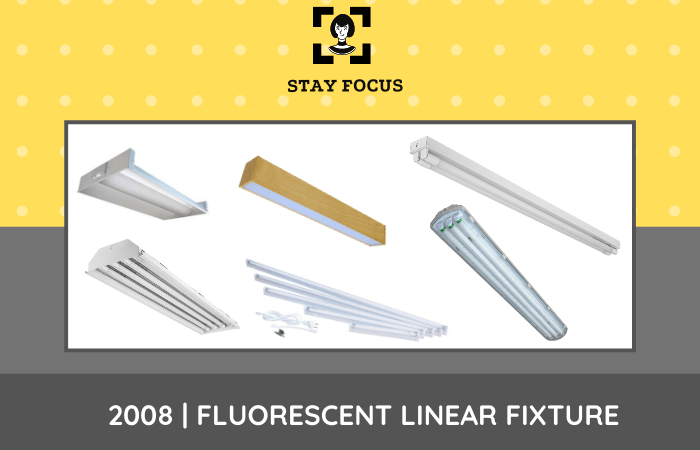
Wraparound vs. Strip Surface Fluorescent Light Types
When selecting a surface mount fixture, you will commonly encounter two main styles: wraparound and strip lights. Though both are overhead fixtures used for general lighting, they differ in how they distribute light. How does a wraparound fluorescent light fixture differ from other surface fixtures? A wraparound fixture features a lens or diffuser that covers the bottom and wraps around the sides of the lamps. This design softens the light and distributes it more evenly, reducing glare.
In contrast, a strip fixture is a simpler, more basic design. It is essentially a metal channel that holds the lamps, which are often left bare or covered with a simple wireguard. This provides direct, downward light and is typically used in utility-focused commercial settings where the quality of light is less of a concern than pure brightness, such as in warehouses or maintenance shops.
Choosing between them depends on the needs of the space.
| Fixture Type | Light Distribution | Common Applications |
|---|---|---|
| Wraparound Fixture | Diffused, multi-directional | Hallways, offices, schools, retail spaces |
| Strip Fixture | Direct, downward | Warehouses, workshops, utility rooms, garages |
The Shift from Fluorescent to LED Tube Ready Fixtures
The lighting industry is constantly evolving to improve energy efficiency and reduce environmental impact. The shift away from traditional fluorescent lighting is a prime example of this progress. Old fluorescent systems consume more energy, contain hazardous mercury, and rely on ballasts that often fail before the lamps do.
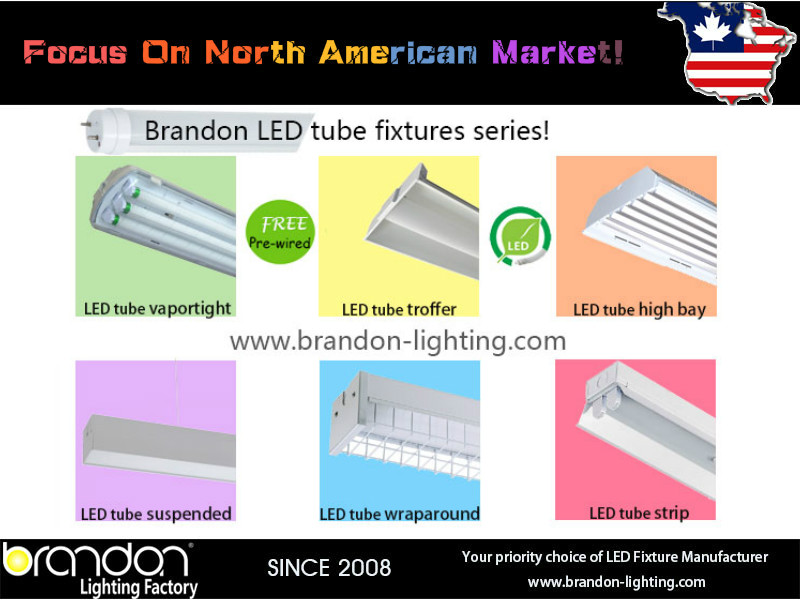
This has led to the rise of the LED tube ready fixture. These modern fixtures maintain the familiar and functional form factor of their predecessors but are engineered specifically for LED tubes. This offers a direct path to upgrading your facility’s lighting, reducing both energy consumption and long-term maintenance headaches.
Why Industry Professionals Still Search for “Surface Fluorescent Light”
Even with the dominance of LED technology, facility managers and electricians frequently search online for terms like “surface fluorescent light” or “surface mount fluorescent light fixture.” This happens for a simple reason: familiarity. These terms describe the fixture style they need to replace. They are looking for a fixture with the same footprint and mounting style as the old one.
The search isn’t necessarily for a fixture that uses fluorescent bulbs, but rather for a direct replacement for an existing one. Contractors need to know that the new fixture will cover the same ceiling area and use the same mounting points to make the fluorescent to LED retrofit process quick and seamless.
This search habit creates a bridge between old and new technology. Your goal is to replace an outdated fluorescent lighting fixture, and the modern solution is an LED tube ready fixture that looks and installs just like the original but performs with far greater efficiency. It’s the evolution of a classic design.
What Does “LED Tube Ready Fixture” Mean?
An “LED tube ready fixture” is a housing, like a wrap or strip light, that is sold without a ballast and is pre-wired to accept ballast-bypass LED tubes. This is a crucial distinction from both traditional fluorescent fixtures and integrated LED fixtures. Instead of relying on a ballast to regulate power, the fixture’s sockets are wired to send line voltage directly to the LED tube.
This design simplifies the entire system. The LED tube has its own internal driver, which manages the power. By eliminating the external ballast, you remove a major point of failure and an energy-consuming component. This makes the fixture more reliable and boosts its overall energy efficiency.
When you purchase an LED tube ready fixture from a manufacturer like Brandon Lighting, you are getting a streamlined, maintenance-friendly light source. It’s designed for a simple fluorescent to LED retrofit, giving you the longevity and energy savings of LED technology in a familiar, easy-to-install package.
Ballast-Bypass Housing and Non-Shunted Sockets Explained
What is involved in retrofitting a surface fluorescent light to an LED tube light fixture? The process centers on two key concepts: ballast-bypass housing and non-shunted sockets. A ballast-bypass housing is simply a fixture designed without a ballast. Power from the building’s main electrical wiring runs directly to the sockets that hold the lamps.
This direct wiring requires a specific type of socket known as a non-shunted socket. In these sockets, the electrical contacts are separate, allowing you to create a complete circuit through the LED tube. This differs from shunted sockets used in some fluorescent fixtures, where the contacts are internally connected.
The key takeaways for a ballast-bypass system are:
- No Ballast: You eliminate the need for an external ballast, reducing failure points and energy loss.
- Direct Power: The fixture is wired to send 120-277V power directly to the sockets.
- Non-Shunted Sockets: These are required to safely power single-ended or double-ended ballast-bypass LED tubes.
- Simpler Installation: For new installations, it’s faster than wiring a fixture with a ballast.
Major Advantages of Upgrading to LED Tube Ready Fixtures
Upgrading your old surface fluorescent lights to modern LED tube ready fixtures offers compelling advantages for any facility manager or property owner. The most immediate benefit is a dramatic reduction in energy consumption, which translates directly to lower utility bills. These fixtures also produce less heat, which can help reduce the load on your HVAC system.
Beyond energy efficiency, the biggest wins come from reduced maintenance costs and increased flexibility. By eliminating ballasts and using long-lasting LED tubes, you spend less time and money on repairs. This upgrade is a smart, forward-thinking investment in your building’s infrastructure.
Lower Energy Consumption Compared to Fluorescent Lighting
How energy efficient are surface fluorescent lights compared to LED surface mount lights? The difference is substantial. Traditional fluorescent lighting was once considered efficient compared to incandescent bulbs, but it pales in comparison to LED technology. A typical fluorescent fixture loses energy through its ballast and in the process of converting electricity into light, which also generates significant heat.
An LED tube ready fixture, on the other hand, uses far less energy to produce the same, if not better, amount of light. By removing the ballast, you eliminate a constant source of energy drain. The LED tubes themselves are also inherently more efficient, converting more electricity directly into visible light. This can lead to energy savings of 50% or more.
While the initial cost of an LED wrap light or strip might be slightly higher than a fluorescent one, the return on investment is rapid. The significant energy savings, combined with reduced maintenance needs, means the upgraded lighting fixture quickly pays for itself and continues to save your facility money for years to come.
Facility Maintenance Benefits: Quick Lamp Replacement & Repair
One of the strongest arguments for choosing an LED tube ready fixture over an integrated LED fixture is for facility maintenance. With an integrated fixture, if the LED array fails, you often have to replace the entire fixture. This is costly, time-consuming, and can disrupt hours of operation. What are the maintenance steps for replacing a lamp? With a tube-ready system, it’s simple.
If a lamp burns out, the repair process is as easy as it was with fluorescents: you just swap the tube. This can be done in minutes by your in-house maintenance staff without needing a specialized electrician. This approach minimizes downtime and keeps repair costs low.
The maintenance-first benefits are clear:
- Easy Repairs: Simply replace the failed LED tube, not the entire fixture.
- No Special Tools: Lamp replacement requires no rewiring or complex work.
- Reduced Labor Costs: Any maintenance team member can perform the swap.
- Minimal Downtime: Your spaces remain lit and operational with quick fixes.
Flexibility with Color Temperature and Lumen Output Changes
Your lighting needs can change over time. A space that starts as a storage room might become an office, or you may decide the current lighting is too cool or too dim. LED tube ready fixtures offer unparalleled flexibility that integrated LED fixtures cannot match. With an integrated fixture, the color temperature (CCT) and lumen output are fixed. If you want a change, you must replace the whole unit.
With a ballast-bypass housing, you have complete control. If you want to change the feel of a room, you simply purchase and install new LED tubes with a different CCT. You can switch from a cool white (4000K) to a daylight-equivalent (5000K) light just by swapping the lamps. The same goes for brightness.
This adaptability makes your lighting system future-proof. As LED technology continues to improve, you can upgrade your visible light output or efficiency by just buying new tubes. This ensures your investment in the fixture housing continues to pay off, allowing you to adapt to new standards or tenant preferences without a major overhaul.
Selecting the Right LED Wrap Light and Surface-Mount Fixture
Choosing the correct LED wrap light or surface-mount fixture is critical for a successful retrofit. Your decision should be guided by the specific needs of the space you are illuminating and a clear understanding of the product’s features and certifications. It’s about more than just brightness; it’s about ensuring durability, safety, and ease of installation.
By assessing the environment—from a simple office hallway to a damp industrial shop—you can select a fixture built to perform reliably in that setting. Making an informed decision now will ensure your lighting system delivers value for years to come.
Assessing Commercial Needs: From Hallways to Industrial Shops
What are the main benefits of using surface fluorescent lights (or their modern LED equivalents) in commercial spaces? The primary benefit is efficient, widespread illumination. However, not all commercial settings are the same. A hallway lighting solution doesn’t need to be as robust as one for a damp workshop. Start by evaluating the environment.
For office hallways, break rooms, and retail stores, an LED wrap light is an excellent choice. Its diffuser provides comfortable, glare-free light suitable for spaces where people are present for extended periods. For warehouse lighting, manufacturing areas, or back-of-house utility rooms, a durable LED strip fixture often makes more sense, prioritizing high lumen output and durability over aesthetics.
Consider these factors for your space:
- Environment: Is the location dry, damp, or subject to dust and debris?
- Occupancy: Is it a high-traffic area requiring pleasant, diffused light?
- Task Requirements: Is bright, direct light needed for detailed work?
- Ceiling Height: Higher ceilings may require fixtures with higher lumen output.
Compliance and Safety Considerations (UL/cUL Listed for Dry and Damp Locations)
When retrofitting any electrical system, safety is non-negotiable. For lighting fixtures in the United States and Canada, the most important safety certifications to look for are UL Listed and/or cUL Listed. These marks indicate that the product has been independently tested and meets rigorous safety standards for electrical and fire risk.
What safety certifications should I look for in a surface fluorescent light for wet environments? For areas with moisture, such as parking garages, commercial kitchens, or certain workshops, you must choose a fixture rated for its location. A “Damp Location” rating is sufficient for areas with ambient moisture but no direct water contact. This ensures the fixture’s components are protected from corrosion and electrical shorts.
Always verify that the LED tube ready fixture you select, like the ones offered by Brandon Lighting, carries the appropriate UL or cUL listing for its intended use. Using certified products not only ensures compliance with building codes but also provides peace of mind that you are installing a safe and reliable lighting system in your facility.
Conclusion
In summary, the transition from traditional surface fluorescent light fixtures to LED Tube Ready options represents a significant advancement in energy efficiency and maintenance convenience for commercial facilities. By choosing LED Tube Ready fixtures, you benefit from lower energy consumption, easy lamp replacement, and the flexibility to modify your lighting setup as your needs evolve. These fixtures not only save on costs but also ensure compliance with safety standards, making them a prudent choice for property managers and electrical contractors alike. If you’re ready to make the switch, consider exploring our range of surface-mounted LED solutions to enhance your facility’s lighting while optimizing performance and cost-effectiveness.
Frequently Asked Questions
What is involved in retrofitting a surface fluorescent light to an LED tube light fixture?
A retrofit involves removing the old fluorescent fixture and replacing it with an LED tube ready fixture. This new ballast-bypass housing is wired directly to line voltage. Then, you simply install the ballast-bypass LED tube. This process eliminates the ballast, boosting energy efficiency and simplifying future maintenance.
Are LED Tube Ready Fixtures compatible with all types of commercial ballasts?
No, and that is their main advantage. LED tube ready fixtures are specifically designed without ballasts. They use non-shunted sockets wired for direct line voltage, making them incompatible with any type of commercial ballast. You must use ballast-bypass LED tubes with these fixtures, which simplifies the system.
How does the footprint of LED Tube Ready Fixtures compare with classic surface fluorescent lights?
LED ready fixtures are designed to match the exact footprint of the classic fluorescent lights they replace. Manufacturers like Brandon Lighting ensure their 2-foot, 4-foot, and 8-foot fixtures have the same dimensions and mounting points, allowing for a seamless installation that covers any marks left by the old fixture.



Leave A Comment