UL listed Hospital Corridor LED Lighting Solutions
In 24/7 healthcare facilities, circulation areas are far more than transitional hallways—they are high-stakes medical operation veins where patient safety, staff efficiency, and rigorous building codes intersect. Sourcing and engineering the ideal lighting concept for hospitals requires a precise balance of technical performance, human-centric visual comfort, and absolute architectural compliance.
As a premier OEM/ODM manufacturer with dual-origin production networks in Guangdong, China, and Thailand, Brandon Lighting provides specification-grade LED solutions designed to meet the elite standards of North American healthcare facilities while mitigating tariff volatility.

The Core Portfolios for Healthcare Circulation Areas
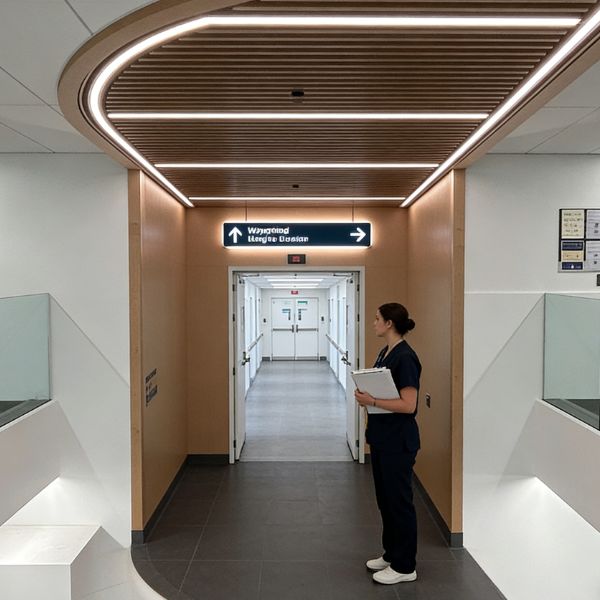
1. Specification-Grade Recessed Linear Slots with Asymmetric Light Distribution
Engineered for main clinical hallways, patient transport tracks, and sterile circulation zones.
Standard center-ceiling lighting configurations create a dangerous, high-glare environment for supine patients on gurneys looking directly at the ceiling. The advanced engineering solution is an asymmetric light distribution layout positioned in an off-center or perimeter configuration along hospital hallways.
-
Design Architecture: Our recessed linear architectural slots feature custom-engineered asymmetric optics that direct smooth, uniform light down walls and across the floor plane from an off-center position. This delivers glare-free illumination that keeps the direct line of sight completely comfortable for resting patients during transit.
-
Plenum Integration: Designed with an ultra-shallow housing to navigate dense, crowded healthcare ceiling grids filled with HVAC, medical gas, and IT infrastructure.
2. Cleanroom-Grade Flat Lens LED Troffers & Architectural Frames
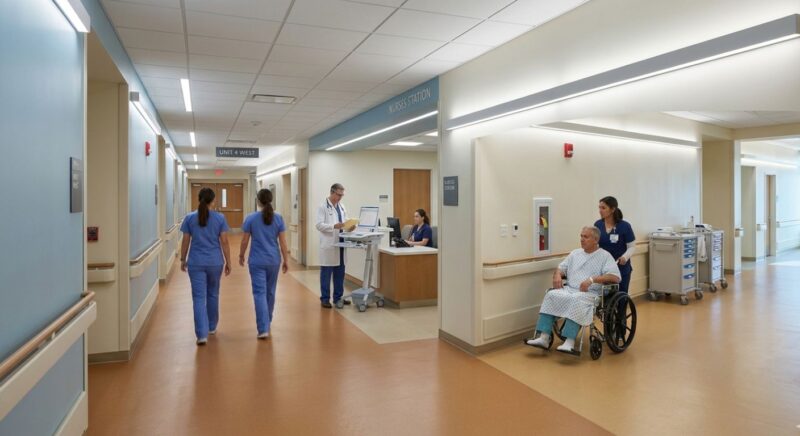
Engineered for triage pathways, intersections adjacent to surgical suites, and high-traffic diagnostic corridors.
Maintaining a sterile atmosphere is paramount in modern medical center design. Traditional center-basket fixtures feature open crevices that collect airborne dust, skin flakes, and pathogens, making them a liability for infection control.
-
Sanitation Engineering: Our architectural troffers utilize a precision-gasketed, dead-flat frosted lens system. The seamless, flush surface prevents any particulate bypass between the ceiling plenum and the clean environment.
-
Finishing: Treated with a heavy-duty, anti-microbial post-painted finish that withstands harsh, medical-grade chemical washdowns and sanitizing agents without degrading or yellowing.
3. Smart Field-Adjustable Linear Strips with Bi-Level Microwave Sensors
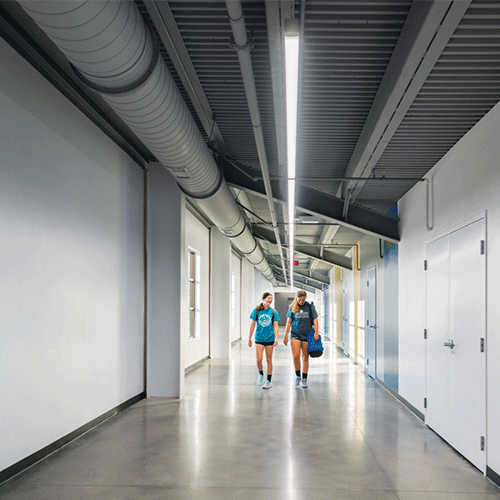
Engineered for staff-only hallways, back-of-house utility zones, and egress staircases.
Hospital corridors must remain illuminated 24/7/365, yet traffic drops drastically during deep-night shifts. Leaving fixtures operating at full capacity in vacant circulation areas wastes enormous amounts of capital.
-
Field-Adjustable Flexibility: Features field-adjustable settings for 4 selectable wattages and 4 selectable CCTs (3000K/3500K/4000K/5000K) via secure internal dip switches, allowing electrical contractors to instantaneously adapt the lumen output and light color on-site based on the specific corridor ceiling height.
-
Factory-Configured Optical Precision: To accommodate varying hallway widths, these linear strips can be factory-configured with specialized optics, including high-transmission diffused lenses or precision long-aisle distribution profiles to concentrate light directly onto the walkway.
-
Smart Energy Controls: Integrated with an internal bi-level dimming microwave sensor. During high-traffic hours, the linear strip operates at full illumination. During periods of vacancy, it dims down to a low-level safety ambient layer (e.g., 20% output), satisfying security camera requirements while slashing energy consumption by up to 80%.
Technical Performance Matrix & Regulatory Standards
To qualify for premium utility rebates and clear rigorous medical inspections, Brandon’s healthcare lighting lineup adheres to strict engineering parameters:
| Metric / Parameter | Healthcare Standard Requirement | Brandon Engineering Implementation |
| Recommended Lux Levels | 200 Lux average during peak daytime hours; 20 – 50 Lux for night paths. | 0-10V deep dimming drivers compatible with centralized hospital control hubs. |
| Color Rendering Index (CRI) | Min. 90 CRI required for accurate clinical assessment of patient skin tones. | High-density LED arrays with balanced spectral output ($R_9 > 50$). |
| Glare Control Standards | Unified Glare Rating (UGR < 19) to prevent visual fatigue and patient dazzle. | Advanced high-transmission micro-prismatic diffusion optics. |
| Regulatory Certificates | UL, cUL Listed for Damp/Wet locations, California Title 24 JA8, DLC Premium. | Fully certified across all families to unlock maximum localized energy rebates. |
Comprehensive Smart Control & Safety Systems
Modern hospital interior design dictates that architectural lighting must adapt dynamically to human circadian rhythms while prioritizing emergency safety:
-
Human-Centric Day/Night Scheduling: Utilizing automated time-scheduling and daylight harvesting sensors, the lighting system delivers crisp 4000K daylight-spectrum light at 200 Lux during peak shift changes, then smoothly transitions to a warm, low-intensity night-lighting environment to foster patient rest and melatonin production.
-
Emergency Lighting Resilience: Integrated, factory-installed emergency battery backup packs (EM Packs) guarantee a minimum of 90 minutes of continuous, code-compliant egress illumination during primary power interruptions.
Supply Chain Security: The Dual-Origin Advantage
Large-scale healthcare construction projects require rock-solid lead times and predictable cost structures. Brandon Lighting solves modern macroeconomic challenges through dual-facility redundancy:
-
Zhongshan Facility: Maximizes high-precision sheet metal fabrication and advanced optical production efficiency.
-
Thailand Facility: Provides a secure, tariff-free shipping origin directly into North America, protecting commercial distributors and electrical contractors from Section 301 duties and logistical volatility.
Technical Frequently Asked Questions (FAQ)
What are the specific illuminance and lux level requirements for hospital corridors?
According to major global healthcare lighting guides (such as Glamox and IES standards), active hospital corridors used for navigation, circulation, and nurse charting stations require an average daylight illumination level of 200 Lux. During late-night hours, this must be dialled down to 20 – 50 Lux via smart control systems to ensure patient comfort while maintaining safety and navigation capabilities for medical staff.
Why is asymmetric light distribution preferred over center-ceiling fixtures in patient pathways?
Center-ceiling functional lighting projects light directly straight down. When patients on gurneys are transported between wards, they look straight up, exposing them to continuous, dazzling glare that causes neurological discomfort and anxiety. An asymmetric or wall-wash distribution throws light from an off-center position toward the corridor walls, illuminating the space through comfortable reflection and maintaining a completely glare-free viewing angle for patients.
How do bi-level dimming sensors improve energy efficiency without risking patient safety?
Instead of completely shutting off functional lighting in vacant hallways—which violates safety codes and impairs security cameras—bi-level sensors drop the luminaire’s power consumption to a pre-set standby level (e.g., 20%). The instant a staff member or patient steps into the circulation area, the integral microwave sensor senses the movement and ramps the light back up to 100% instantly, delivering a blend of maximum energy efficiency and absolute safety.
What certifications are mandatory for lighting fixtures in sterile healthcare corridors?
Fixtures must carry UL/cUL listings for damp or wet locations depending on the specific cleaning protocols. Additionally, areas bordering cleanrooms or infection-control zones require sealed, flat-lens configurations that prevent particulate transfer through the ceiling grid. For energy code compliance and financial feasibility, listing on the DLC Premium QPL and meeting California Title 24 standards are essential to capture utility rebates.
Streamline Your Healthcare Project Submittals
Gain immediate factory support to lock in your next commercial healthcare bid:
-
Access full IES Photometric Files, Revit/BIM Models, and Engineering Submittal Sheets.
-
Request customized factory pre-configurations for specialized hospital corridors.
Request Factory-Direct Quotes & Spec-Grade Pricing
Supplying Premium UL-Listed Linear Fixtures Since 2010