
Key Highlights
- High voltage LED lighting remains common in commercial lighting because it supports large spaces with strong reliability.
- It helps reduce voltage drop over long runs, which supports optimal performance in bigger buildings.
- Direct line voltage lighting can simplify the installation process in many retrofit and new-build projects.
- Many commercial LED fixtures are built for durability, long life, and lower maintenance demands.
- Low-voltage lighting still fits selected outdoor lighting, accent, and landscape lighting applications.
- Choosing the right commercial lighting voltage depends on layout, controls, environment, and fixture compatibility.
Introduction
Voltage selection affects how well a lighting system performs, how far power can travel, and how practical installation will be in commercial buildings. That is why high voltage LED lighting still dominates many offices, schools, healthcare facilities, warehouses, retail stores, and parking garages. In most commercial settings, the goal is simple: deliver stable LED lighting across large areas with fewer power issues, lower operational costs, and dependable day-to-day performance. Understanding that choice helps you specify the right system.
Understanding Commercial Lighting Voltage Selection
Choosing commercial lighting voltage is not just a technical box to check. It shapes wiring methods, fixture compatibility, and system layout across commercial spaces. A poor match can lead to unnecessary complexity or performance limits.
In practice, voltage selection often comes down to run length, fixture type, and how much risk of voltage drop a project can tolerate. That is why designers and contractors usually start with building power conditions before choosing specific commercial LED fixtures.
Why Voltage Matters in Commercial LED Lighting Systems
Commercial buildings prefer using high voltage lighting systems because voltage affects how efficiently power reaches each fixture. In large floorplans, you need enough power delivered consistently from one end of the space to the other. If that does not happen, brightness and system stability can suffer.
Higher voltage helps reduce energy loss over longer wiring distances. That matters in office lighting, warehouse lighting, and parking garage lighting, where fixtures may be spread across wide areas or continuous rows. A system that performs well over distance is easier to scale.
There is also a practical side. High voltage LED lighting often works directly from standard building power, which supports a cleaner installation approach in many commercial lighting systems. For large facilities, that combination of energy efficiency, reach, and simplicity is a major reason line voltage lighting remains standard.
Common Commercial Lighting Voltage Ranges and Regional Standards
Commercial LED fixtures can operate across several voltage ranges, depending on the building and regional standards. In many projects, high voltage lighting refers to 120–277V, 120–347V, or other line voltage ranges tied to local electrical service. Some products, such as HV LED strip light systems, also operate at 110V or 220V.
The main point is compatibility with available building power and the breaker arrangement serving the lighting circuit. Fixtures commonly designed for high voltage include troffers, linear fixtures, floodlights, strip light products, and area lighting used in commercial spaces.
| Voltage Range | Typical Context |
|---|---|
| 12V or 24V | Low-voltage landscape lighting, path lights, and accent applications |
| 110V or 220V | HV strip light applications based on regional standards |
| 120–277V | Common commercial lighting voltage for many indoor fixtures |
| 120–347V | Used in some commercial and institutional settings |
What Is High Voltage LED Lighting?
High voltage LED lighting refers to LED fixtures designed to operate from line voltage or other higher-voltage building power rather than low-voltage transformer-fed circuits. In commercial work, that usually means fixtures that connect more directly to the facility’s electrical system.
This approach is common because it supports a practical lighting system for larger buildings. Instead of using low-voltage layouts meant for short decorative runs, high voltage LED fixtures are used where scale, wiring distance, and operational consistency matter more.
Defining High Voltage LED Fixtures and Line Voltage LED Lighting
Yes, high voltage LED lights can be used in commercial environments, and many already are. High voltage or line voltage lighting means the fixture is built to run from standard AC mains or similar building supply ranges without relying on the kind of low-voltage transformer setup common in landscape lighting.
That makes these products especially useful in larger commercial lighting systems. Examples include linear fixtures, area fixtures, floodlights, and certain strip light products used for commercial, architectural, and outdoor lighting. In those settings, long uninterrupted runs and broad coverage are often more important than compact low-voltage control layouts.
The distinction matters because line voltage products are generally selected for scale and integration with existing power. By contrast, low-voltage fixtures are more often chosen for path lights, patios, walkways, and focused outdoor space applications.
How High Voltage LED Lights Operate in Commercial Environments
High voltage LED lights operate by taking building power directly into the fixture or its internal driver arrangement, depending on product design. In commercial environments, this supports simpler wiring over broad areas and reduces the need for multiple external transformers.
That operating model is one reason they are widely used in industrial applications and large commercial spaces. Long runs are easier to manage, and consistent brightness is easier to maintain. Lower energy loss across distance can also help control operational costs in facilities that keep lights on for long hours.
Installation and maintenance still require proper planning. Contractors need to match fixture input ratings, circuit conditions, and controls, while also accounting for voltage spikes and environmental demands. So yes, high voltage lighting requires professional installation practices, but not necessarily a more complicated maintenance routine once the right system is in place.
Key Benefits of High Voltage LED Lighting in Commercial Buildings
The continued use of high voltage LED lighting comes down to measurable project advantages. In commercial buildings, decision-makers typically care about energy efficiency, durability, reliability, and installation practicality more than novelty.
High voltage lighting aligns with those goals in many common applications. It supports long runs, stable brightness, and easier integration with building power. The next sections break down the main reasons commercial LED lighting systems often stay with high voltage instead of switching to low-voltage layouts.
Energy Efficiency and Cost Savings for Large Facilities
For large commercial areas, high voltage lighting can be more energy efficient because it reduces energy loss across longer wiring distances. When fixtures are spread throughout offices, warehouses, or garages, that matters. Power delivery stays more stable, which supports dependable light output.
The savings are not just about the LED source itself. System design also affects operational costs. A layout that avoids unnecessary transformers and limits voltage drop can be more efficient to install and simpler to maintain over time.
Key advantages include:
- Better energy savings on long runs where low-voltage systems may lose brightness.
- Lower operational costs through simpler power distribution in larger spaces.
- More consistent performance across extensive commercial lighting layouts.
That does not mean every project should use high voltage. It means large facilities often benefit from it most.
Reliability and Performance of High Voltage Fixtures
High voltage lighting systems are often more reliable for commercial applications because they are designed for steady operation across broad areas. In buildings that need daily, long-hour use, fixture stability matters as much as efficiency. You want fewer weak spots, less uneven brightness, and predictable output.
Another advantage is longevity. The compiled information on LED products highlights long life and reduced replacement frequency as a core benefit of LED technology. In commercial settings, that translates into lower maintenance costs and less disruption for occupants and staff.
Reliability also supports optimal performance in spaces where lighting quality affects work, safety, or visibility. Whether you are specifying office lighting or warehouse lighting, a dependable high voltage setup can make the overall commercial lighting system easier to manage throughout its service life.
Simplified Installation and Maintenance for High Voltage Lighting
One reason many projects favor high voltage LED lighting is the installation process. Because many high voltage fixtures work with available building power, designers can avoid adding multiple transformers that would otherwise complicate layout, access, and future service planning.
That is especially helpful in retrofit work, where existing conduits and branch circuits may already support line voltage lighting. Using compatible commercial LED fixtures can reduce disruption and make upgrades more direct. Fewer extra components can also mean fewer future failure points.
Maintenance tends to be straightforward when the system is correctly specified from the start. Yes, electricians still need to follow proper procedures, verify compatibility, and protect the system from issues like voltage spikes. Still, in many commercial buildings, high voltage lighting does not create unusual maintenance costs compared with other standard lighting products.
Supports Long Continuous Lighting Runs
A major difference between high voltage lighting and low voltage lighting is how each handles long runs. High voltage systems are better suited to extended wiring layouts where fixtures need to stay bright and uniform over distance. That is a core need in commercial buildings.
The compiled material notes that HV strip light products can run up to 50 meters in a single run without noticeable brightness loss. That same principle matters in larger commercial lighting systems. Reduced voltage drop allows designers to extend lighting coverage while maintaining a more consistent result.
Low-voltage systems can still work well, but they often need more careful transformer placement and wiring strategies to avoid output variation. In large spaces, high voltage LED lighting usually provides a more practical path for continuous linear lighting, open-area coverage, and cleaner system planning.
Ideal for Commercial Retrofit Projects
A commercial building should choose high voltage over low voltage when the project involves large interior areas, existing line-voltage infrastructure, or a retrofit where simplicity matters. In those cases, matching the new lighting system to available building power can save time and reduce design friction.
Compatibility is a big part of that decision. Many retrofit projects succeed because the new commercial LED fixtures can align with the electrical framework already in place. That makes it easier to replace older lighting products without rebuilding the entire distribution approach.
High voltage also makes sense when the goal is broad illumination rather than decorative accent lighting. If the building needs dependable office lighting, school lighting, healthcare lighting, or warehouse lighting across large zones, high voltage usually offers the more practical retrofit path.
Where High Voltage LED Lighting Is Commonly Used
High voltage LED lighting appears across many commercial applications because most large buildings need stable, scalable illumination. The system choice is rarely about trend. It is about matching the electrical design to the function of the space.
From office floors to industrial facilities, different applications place different demands on brightness, durability, and wiring distance. The examples below show why high voltage remains the default in many commercial spaces, even while low-voltage lighting still serves specialized roles.
Office Buildings
Office buildings often use high voltage LED lighting for general illumination, linear runs, and indirect lighting effects. Common high-voltage fixture types in these environments include linear fixtures, strip light systems, and other commercial LED fixtures designed for broad interior coverage.
Good office lighting must balance brightness and glare. That is easier to manage when the lighting system delivers uniform output across long ceiling spans, corridors, or open-plan work areas. Stable power helps support optimal performance throughout the day.
High voltage layouts also fit the scale of office retrofits and new construction. Since large floorplates usually depend on centralized electrical distribution, line voltage lighting integrates naturally. For architects and engineers, that makes planning more efficient than trying to build a low-voltage system for every zone.
Schools and Universities
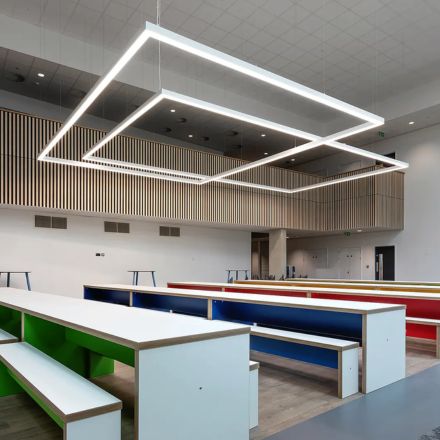
Schools and universities should choose high voltage lighting when they need durable, building-wide illumination with manageable upkeep. Classrooms, corridors, libraries, and common areas all benefit from a commercial lighting system that can support frequent daily use without complicated power distribution.
Durability matters in educational settings. Fixtures are expected to last, and replacement cycles can strain maintenance teams. LED technology already supports long life, and high voltage layouts help maintain consistent performance across larger campuses and interconnected facilities.
Energy savings are another driver. Educational buildings often operate long hours, which makes efficiency and operational simplicity important. For school lighting, high voltage LED lighting is usually the better fit for broad indoor applications, while low-voltage products remain more suitable for selective exterior path lights or decorative campus landscape lighting.
Healthcare Facilities
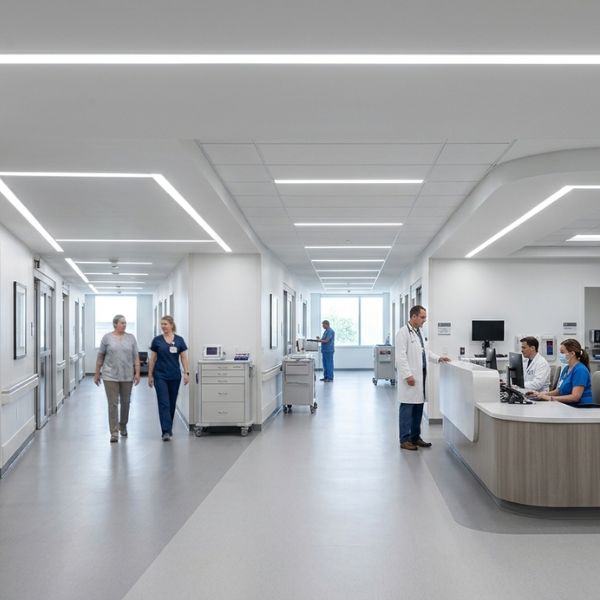
Healthcare lighting needs strong reliability because visibility affects safety, task performance, and the comfort of patients and staff. In these environments, high voltage LED lighting is commonly preferred for general lighting systems that must operate consistently across treatment areas, corridors, and support spaces.
Reliability is one of the strongest arguments for high voltage in healthcare. A stable commercial lighting voltage helps reduce uneven output across long layouts, while LED longevity can reduce interruptions tied to replacement work and maintenance scheduling.
Some facilities also pair broad high-voltage infrastructure with smart lighting controls for more flexible operation. That does not change the underlying need: healthcare facilities benefit from a dependable power and fixture strategy first. For most large interior healthcare applications, high voltage remains the practical standard.
Warehouses and Industrial Facilities
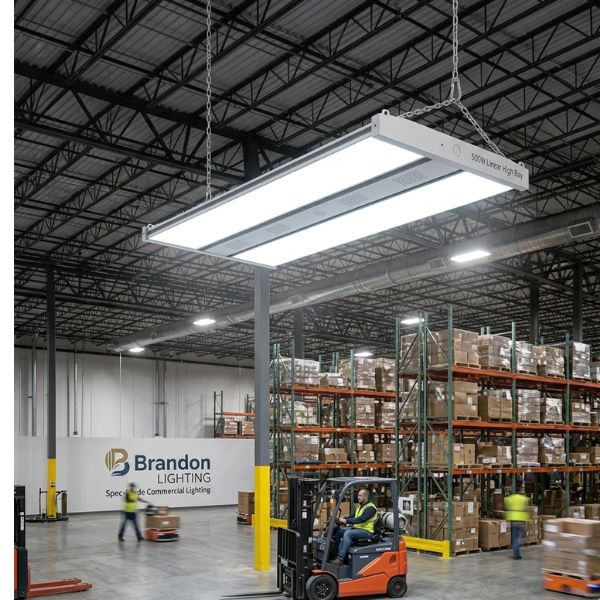
Warehouses and industrial applications are some of the clearest examples of where high voltage lighting belongs. These facilities often have high ceilings, long aisles, and broad open zones that demand strong, even illumination over distance.
High-voltage fixture types in these spaces include linear fixtures, strip light products, floodlights, and other commercial LED fixtures used to replace older HID systems. The goal is not decorative lighting effects. It is dependable coverage, reduced energy loss, and practical wiring in large interiors.
Because these buildings often run extended hours, performance and maintenance matter. High voltage LED lighting supports long runs and stable brightness, which is critical in warehouse lighting. For contractors and facility teams, that makes the system easier to scale and easier to keep operating efficiently.
Retail Stores
Retail lighting often combines general illumination with accent layers, and high voltage usually handles the main system. The difference from low-voltage lighting is practical: high voltage supports broad store coverage, while low voltage is more often reserved for selected accent or outdoor details.
In retail stores, the installation process benefits from using fixtures that work with standard building power. That is useful for long ceiling runs, perimeter lighting, and display-area illumination where consistency matters. Energy efficiency is also important because stores operate for long business hours.
Color temperature and brightness still need careful selection, but those are fixture decisions within the larger electrical framework. For most interior retail lighting, high voltage remains the standard platform, while low-voltage products are better suited to niche decorative effects or exterior landscape zones.

Parking Garages
Parking garage lighting needs durability, stable output, and coverage across long structural spans. That makes high voltage LED lighting a strong choice. One of the main advantages in these commercial spaces is reduced voltage drop over extended runs, which helps maintain consistent visibility.
Garages also benefit from fixtures built for demanding operating conditions. Durability matters because lights may run for long hours in environments exposed to dust, temperature changes, and vehicle traffic. Fewer service calls can lower maintenance burden over time.
Motion sensors are often used in these settings to improve control and efficiency. Even with those controls, the base system still depends on reliable power distribution. For parking garage lighting, high voltage provides the practical backbone needed for broad coverage and dependable operation.
Comparing High Voltage vs. Low Voltage Lighting in Commercial Spaces
Not every project should use high voltage. Low voltage still has a clear role in commercial spaces, especially where outdoor lighting, decorative control, or smaller-scale lighting effects matter more than broad interior coverage.
The real comparison is not which approach is better in every case. It is which one fits the application. High voltage typically serves large building systems, while low voltage often supports selected accent, patio, path, or landscape lighting needs.
Safety Considerations, Applications, and Practical Differences
Yes, there are safety considerations with high voltage lighting in commercial buildings. The system must be installed correctly, matched to the breaker and circuit design, and protected from issues such as voltage spikes. That is why commercial projects rely on qualified electrical planning and installation.
Low-voltage systems have their own value. The compiled information shows they are common in landscape lighting, path lights, walkways, patios, and other outdoor space applications where a transformer-fed setup supports focused lighting and easier decorative placement.
Practical differences include:
- High voltage usually supports large commercial lighting systems and long runs more effectively.
- Low voltage often uses a transformer and suits accent or landscape layouts.
- High voltage reduces brightness loss over distance more successfully.
- Low voltage can be a better choice where smaller-scale outdoor lighting effects are the goal.
| Factor | High Voltage LED Lighting | Low-Voltage Lighting |
|---|---|---|
| Best use | Large indoor commercial spaces | Landscape lighting and accent outdoor space |
| Power method | Direct line voltage or higher input voltage | Transformer-fed 12V or 24V |
| Long runs | Strong performance with less voltage drop | More risk of brightness loss over distance |
| Typical examples | Office lighting, warehouse lighting, parking garage lighting | Path lights, walkways, patio lighting |
How to Choose the Right High Voltage LED Fixtures
Selecting the right lighting system requires more than picking a fixture shape. You need to review input voltage, controls, mounting approach, environmental exposure, and product approvals. Those choices affect compatibility, durability, and long-term maintenance.
For architects, contractors, distributors, and owners, the goal is to match fixture performance to the building’s actual operating conditions. The following points offer a practical checklist for choosing high voltage LED lighting with fewer surprises during installation and use.
Consider Input Voltage
Commercial LED lights use different input voltage ranges depending on fixture design and project type. Some use 120–277 volts or 120–347 volts, while certain HV strip light products operate at 110V or 220V based on regional needs. The first step is confirming what the fixture actually accepts.
That matters because the system must provide enough power without mismatch. If the available building supply and the fixture input voltage do not align, performance and safety can both suffer. This is a basic but essential part of commercial lighting voltage planning.
Always review product specifications before purchase. In retrofit work, input range can determine whether a fixture integrates smoothly with existing circuits. In new construction, it helps engineers and contractors coordinate the right lighting system with the wider electrical design.
Check Dimming Compatibility
Some LED fixtures can work with multiple input voltages, but that does not automatically guarantee dimming compatibility. Multi-voltage products still need control systems that match their driver design and intended operating range. You should verify both power and control details together.
This is important when a project depends on lighting effects, adjustable brightness, or smart lighting functions. A fixture may operate correctly at several voltage levels yet still require a specific dimming method to perform as expected.
Before specifying products, confirm compatibility between the fixture, dimmer, and control strategy. That helps avoid flicker, poor response, or uneven output. In commercial lighting systems, dimming should be treated as a technical requirement, not an assumed feature based only on the input voltage range.
Evaluate Installation Method
The installation process should match the fixture and the site conditions. High voltage lighting does require professional installation procedures, especially when wiring layouts, access points, and existing circuits need to be coordinated across large commercial areas.
Start by asking practical questions. Will the fixture mount to a finished ceiling, a structural surface, or an exterior location? Does the project benefit from long continuous runs, or does it involve segmented layouts? These details affect labor, routing, and service access.
A durable product only performs well if it is installed correctly. Review connection methods, environmental exposure, and how future maintenance will be handled. In commercial spaces, an efficient installation method can be just as important as fixture efficiency when evaluating total project value.
Select the Proper IP Rating
IP rating becomes critical when high voltage fixtures are used in outdoor lighting or exposed commercial environments. The compiled material notes that many HV strip light products include robust protective coatings and that IP65 and above are recommended for outdoor applications.
That guidance matters for fixture durability. Parking structures, facades, exterior retail zones, and other exposed areas need products built to resist weather and contamination. The wrong IP rating can shorten service life, even if the electrical specification is otherwise correct.
Types of high-voltage fixtures that may need careful IP review include floodlights, strip light products, and other exterior commercial LED fixtures. By contrast, low-voltage path lights and similar landscape products also need environmental protection, but they serve a different application and power strategy.
Verify Certifications
Certifications matter because safety in commercial lighting depends on more than voltage alone. You need lighting products that are evaluated for their intended use, especially when they will operate for long hours or in demanding environments.
This is one of the most important safety considerations in high voltage lighting. Certified fixtures help reduce risk tied to installation errors, unsuitable application, or environmental mismatch. They also give contractors and specifiers clearer guidance on where and how the product should be used.
Before buying, verify certifications alongside voltage range, control compatibility, and IP rating. That step helps confirm the product is appropriate for the project rather than simply functional in theory. In commercial spaces, proper approvals support safer installation and more reliable long-term performance.
Frequently Asked Questions About High Voltage LED Lighting
Common inquiries often revolve around the safety and performance of high voltage LED lighting systems. High voltage real estate offers advantages such as lower energy losses over longer runs, making installation in expansive areas, like parking garages or large retail environments, more efficient. Additionally, questions about compatibility with existing infrastructures and the role of intelligent systems like motion sensors in enhancing energy efficiency frequently arise. These considerations are crucial for maintaining optimal performance while minimizing operational costs and ensuring durability.
What voltage do commercial LED lights use?
Commercial lighting products use several voltage ranges, commonly 120–277 volts, 120–347 volts, or other regional line-voltage options. Some high voltage products also operate at 110V or 220V. The right voltage helps reduce energy loss and supports better performance across larger commercial lighting layouts.
Why do commercial buildings use 277V lighting?
Commercial spaces use 277V lighting because higher voltage can deliver enough power more effectively across larger areas. That helps reduce voltage drop and supports optimal performance in long runs. It is a practical fit for buildings that need broad, reliable illumination from centralized electrical distribution.
Is high voltage lighting more energy efficient?
In large facilities, high voltage lighting can improve energy efficiency by reducing losses over longer wiring distances. That can support energy savings and lower operational costs. Combined with LED durability and long service life, it becomes a strong option for many commercial applications.
Can LED fixtures work with multiple input voltages?
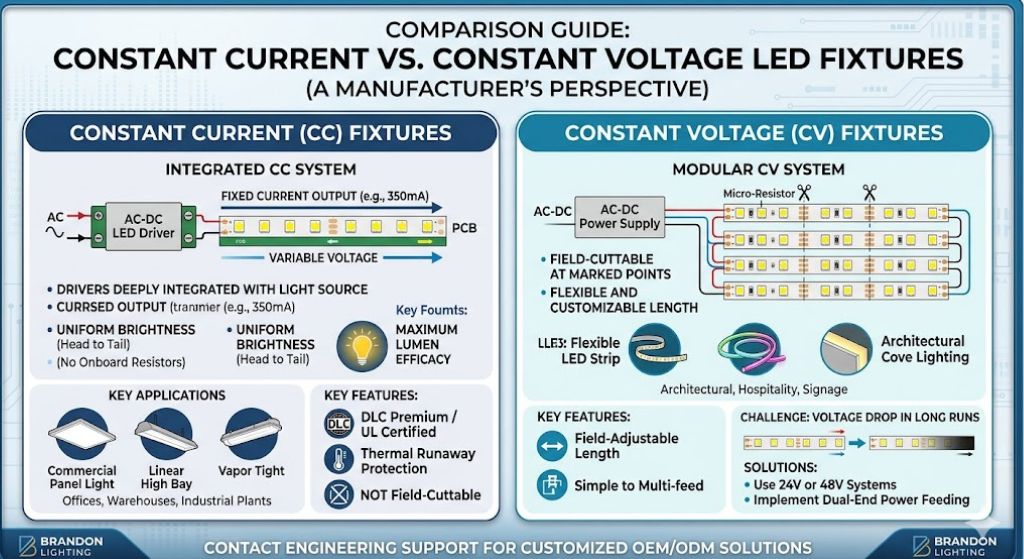
Yes, some LED fixtures are designed for multiple input voltage ranges, but compatibility must be verified in the product specifications. That includes control gear and dimming. Unlike low-voltage strip light systems that rely on transformers, multi-voltage fixtures must still maintain stable brightness within their rated range.
Is high voltage lighting safe?
High voltage lighting is safe when the breaker, fixture rating, and installation process are properly matched. Qualified installation is essential, especially where voltage spikes or environmental demands are concerns. When specified correctly, it does not automatically create higher maintenance costs than other standard commercial systems.
Conclusion
In conclusion, high voltage LED lighting remains the preferred choice for many commercial buildings due to its energy efficiency, reliability, and simplified installation processes. It provides significant cost savings, especially for large facilities needing long continuous runs of lighting. While there are scenarios where low-voltage systems may be more appropriate, such as in specific applications like landscape lighting or delicate environments, high voltage lighting continues to dominate the market due to its practicality and performance benefits. Understanding the various aspects of high voltage commercial lighting is crucial for architects, engineers, and facility managers in making informed decisions. For those looking to explore quality commercial LED fixtures, consider Brandon Lighting’s solutions tailored to meet diverse needs in the commercial sector.


Leave A Comment