
Key Highlights
- Linear high bay lights suit higher mounting height and open warehouse zones that need stronger light output.
- Linear strip lights work well where uniform illumination matters more than maximum brightness.
- Light distribution differs by fixture design, beam angle, and ceiling layout across warehouse aisles and work areas.
- Both options support energy efficiency, but fixture selection should match the amount of light required.
- Installation flexibility varies, with strip lights often used for simpler runs and high bay lights for taller spaces.
- The best choice depends on ceiling height, coverage goals, and warehouse tasks.
Introduction
Choosing the right warehouse lighting affects safety, visibility, and operating costs in industrial spaces. That is why many facilities compare high bay lights and linear LED fixtures before making a purchase. Linear high bay and linear strip lights are both popular because they offer energy efficiency, practical fixture types, and flexible use across storage and work areas. Still, they are not interchangeable in every setting. Your ceiling height, floor plan, and lighting target will determine which option performs better.
Understanding Linear High Bay and Linear Strip Lights for Warehouses
In modern indoor lighting, linear high bay lights and strip lights are two common fixture types used in warehouse and commercial applications. Both support efficient operation, but they serve different layouts and lighting needs.
Linear high bay lights are built for larger spaces and taller installations, while strip lights are often chosen for closer mounting and even coverage. If you want the right choice for your warehouse lighting plan, it helps to understand how each fixture is designed to work before comparing performance in detail.
What Is a Linear High Bay Fixture?
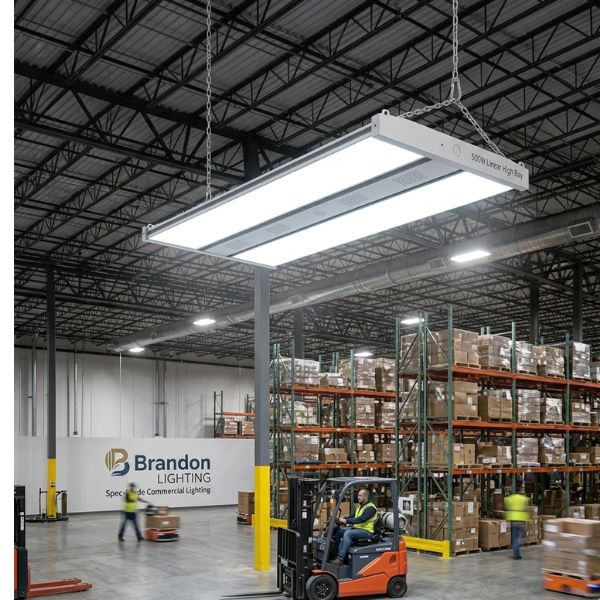
A linear high bay fixture is a rectangular linear LED light made to deliver broad, powerful high bay lighting in industrial spaces. Its shape supports wide distribution while keeping a clean fixture profile over open areas, warehouse aisles, and production zones.
These high bay lights are intended for high ceilings and should be installed at a mounting height of at least 18 feet. Available lengths commonly range from 1 to 4 feet, with beam angles from 90° to 120°. Product examples in this category run from about 11,900 lumens to 84,000 lumens, showing the higher lumen output these fixtures can provide.
The main difference between linear high bay and linear strip lights starts here. A linear high bay is designed for stronger light output at higher mounting height, which makes it a better fit when your warehouse needs more punch, wider spacing, and energy savings in larger ceiling-mounted applications.
Overview of Linear Strip Lights in Warehouse Applications
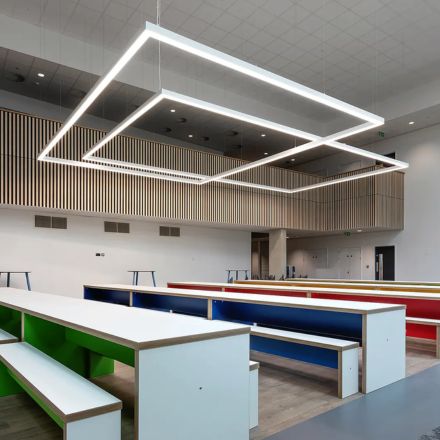
Linear strip lights are slimmer linear LED fixtures commonly used as a ceiling light where steady, uniform light matters more than very high output. In warehouse applications, they can support task visibility in lower sections, smaller rooms, or long runs where the goal is balanced coverage.
Because of their form, linear strip lights are often selected for commercial lighting layouts that value consistent light distribution. They can be used in warehouses, retail stores, and similar indoor spaces where a surface mount setup or simple continuous arrangement is preferred.
Compared with a linear high bay, strip lights are not centered on high ceilings or maximum brightness. Their advantage is smoother visual coverage and installation versatility. If your project needs uniform illumination across lower mounting areas, linear strip lights may be the more practical option.
Key Differences Between Linear High Bay Fixtures and Linear Strip Lights
At first glance, both products are linear fixtures, but their purpose is different. Linear high bay models are built as high bay lighting solutions for taller warehouse conditions, while strip lights are more often used where mounting is lower and the light pattern needs to stay soft and even.
The biggest differences come down to fixture shape, output, and coverage style. In commercial lighting, one fixture may favor stronger intensity from above, while the other supports uniform light distribution across tighter areas. Those differences become clearer when you compare brightness and light spread side by side.
Light Output and Brightness Comparison
Yes, a linear high bay light is generally brighter than strip lights in a warehouse setting when you compare typical use. High bay models are made for higher ceilings, so they need more light output to reach the floor effectively and maintain usable brightness below.
Compiled product data for linear high bays shows outputs from roughly 11,900 to 84,000 lumens, with common beam angle options such as 90°, 110°, and 120°. Some fixtures also offer selectable beam angle choices like 45° x 100°, 65° x 95°, and 90° x 90°, which helps direct the amount of light based on layout.
| Fixture Type | Typical Wattage Range | Typical Lumen Range | Ideal Mounting Height |
|---|---|---|---|
| Linear high bay light | 85W to 600W | 11,900 to 84,000 lm | At least 18 ft |
| Linear strip lights | Lower-output use cases vary by project | Lower than high bay in most warehouse comparisons | Lower ceiling applications |
Differences in Light Distribution and Coverage
Light distribution is one of the most important differences between these fixtures. Linear high bays are designed to send light down from higher points, using beam spread options that balance floor brightness and coverage. Strip lights, by comparison, are usually chosen when the goal is uniform illumination across a lower plane.
In a warehouse, this affects how much uniform coverage you get and where dark spots may appear. High bays can cover larger open areas, but spacing and beam angle matter. Guidance for high bays suggests spacing of 12 to 15 feet under 20-foot ceilings, 15 to 20 feet for 20 to 30 feet, and 20 to 30 feet above 30 feet.
- Linear high bays support stronger downward light pattern for taller spaces.
- Linear strip lights are better for smoother coverage in lower sections.
- Poor fixture spacing with either type can create dark spots and uneven light distribution.
Energy Efficiency and Performance in Warehouse Lighting
Energy efficiency matters in warehouse lighting because fixtures often run for long hours over large floor areas. Both led linear high bay lights and linear strip lights can lower energy consumption compared with older metal halide, halogen, incandescent, or fluorescent systems while still providing useful brightness.
Still, the more efficient option depends on application, not just fixture name. If a tall warehouse needs stronger output, high bays may deliver better performance with fewer fixtures. If your area needs lower-mounted, even coverage, strip lights may avoid overspending on output. That is why performance and sustainability should always be reviewed together.
Power Consumption of Linear High Bay vs Linear Strip Lights
Power consumption is measured in watts, so it shows how much energy a fixture uses. LED products are known for using less power than incandescent, halogen, metal halide, and fluorescent options while producing the same or better usable brightness. That creates real energy savings in warehouse operations.
For linear high bay products in the compiled data, wattage ranges from about 80W to 600W, with many selectable wattage models available. Even at higher wattages, these linear LED fixtures replace much larger metal halide systems, including 400W, 750W, 1,000W, and even 1,500W equivalents.
So which fixture types are more energy efficient? In practice, the answer depends on fit. A high bay may use more watts per fixture but can light higher spaces correctly. A strip light may use less power in lower areas. The most efficient setup is the one that matches ceiling height, output need, and fixture count.
Impact on Electricity Costs and Sustainability
Electricity costs are shaped by wattage, run time, and how many fixtures your warehouse needs. LED systems help reduce those costs because they deliver strong output with lower energy use than older technologies. Many linear high bay products also include cct selectable and selectable wattage features, which can simplify planning and prevent overlighting.
Sustainability is also tied to service life and upkeep. Compiled information shows linear high bay fixtures with at least a 50,000-hour rated life, and some lasting up to 100,000 hours. Longer life means fewer replacements and lower maintenance costs over the long run.
- Lower energy use helps cut electricity costs across large facilities.
- Longer service life reduces replacement frequency and labor needs.
- Options like motion sensors and daylight sensors can improve energy savings further.
Installation Requirements for Warehouse Lighting
Installation requirements vary with fixture shape, mounting height, and the size of your warehouse. In open spaces with high ceilings, linear high bay fixtures are designed to project light from much higher positions, so layout planning and spacing are important from the start.
Wiring and maintenance also affect your final decision. Some ceiling light systems are easier to access, while others reduce service needs because they last longer or support sensors and dimming. Before choosing between high bays and strip lights, it helps to look at mounting methods, ceiling conditions, and future upkeep together.
Mounting Options and Ceiling Heights
If your warehouse has high ceilings, linear high bay lights are usually the better option. Compiled guidance states that linear high bays should be installed on ceilings at least 18 feet from the ground. They are made to maintain performance from that mounting height while supporting proper beam spread.
Linear high bay mounting options include surface mount, suspension mount with chains, and pendant mounting brackets. Most come with suspension hardware, while other brackets are often available separately. These options help adapt the fixture to warehouse structure and ceiling height.
- Choose linear high bay lights for high-ceiling warehouses needing stronger downward coverage.
- Use surface mount or suspended options based on structure and service access.
- Strip lights are generally better suited to lower ceiling height applications, not very tall spaces.
Wiring and Maintenance Considerations
Wiring requirements depend on the fixture model and control features you select. Many linear high bay fixtures support 0-10V dimming, and some are sensor ready for motion sensors or daylight sensors. Available voltage options in the compiled data include 120-277 VAC and 120-347 VAC, with some higher-voltage choices as well.
From a maintenance standpoint, LED fixtures reduce replacement frequency because of their long rated life. Linear high bays are specifically promoted as a way to avoid the upkeep tied to older tube and ballast systems. That can lower maintenance costs over the long run, especially in hard-to-reach warehouse zones.
You should also think about future service access and control needs. Sensor-ready models can improve efficiency, and optional accessories may simplify operation. While emergency battery backup was listed as a relevant planning term, your main practical focus should be safe wiring, proper controls, and installation by a licensed electrician.
Selecting the Right Fixture for Warehouse Needs
The right choice depends on how your warehouse is used every day. Different fixture types support different results in warehouse aisles, open areas, and production lines. You need to match output, spacing, and fixture placement to the tasks happening below.
Just as important, think about uniform illumination and visual comfort. Some spaces need broad overhead coverage, while others need smoother light through lower work zones. Motion sensors can also improve performance where activity changes throughout the day. With those goals in mind, it becomes easier to decide which fixture belongs where.
When to Choose Linear High Bay Fixtures
Choose linear high bay lights when your warehouse has higher ceilings and needs stronger high bay lighting from above. These fixtures are built for bigger vertical spaces and can provide higher lumen output while still supporting broad coverage through the work area.
They are especially useful when you need fewer, more powerful fixtures across open warehouse sections. Compiled guidance also shows that high bays can be spaced farther apart as ceiling height increases, making them practical for large layouts where light must travel a greater distance.
- Use them in warehouses with mounting heights of 18 feet or more.
- Select them for open areas, assembly lines, and large work zones needing stronger light.
- Choose them when uniform illumination is required from higher fixture positions.
Best Use Cases for Linear Strip Lights
Linear strip lights are the better fit when you want smooth, even coverage in areas that do not require the punch of a high bay fixture. Their slimmer form supports a modern design and works well where the visual goal is clean lines with steady brightness.
In warehouse settings, that can make sense for lower-mounted sections, support rooms, or long aisles where close, continuous coverage matters. The same qualities also make linear strip lights common in retail spaces and other commercial interiors where fixture appearance and uniform light distribution matter.
- Use them for long aisles and lower ceiling applications.
- Consider them where easy installation and simple runs are priorities.
- Choose them when you want balanced light rather than very high output.
Conclusion
In conclusion, selecting the right lighting for your warehouse is crucial for optimizing both energy efficiency and operational effectiveness. Linear high bay fixtures are ideal for high ceilings and large areas due to their superior brightness and light distribution, while linear strip lights offer versatility and ease of installation in lower spaces. Understanding the differences between these options will enable you to make informed decisions that align with your specific needs and budget. As you evaluate your lighting solutions, remember that the right choice not only enhances visibility but also contributes to sustainability and cost savings. If you have further questions or need assistance in choosing the best lighting fixtures for your warehouse, get in touch with our experts today.
Frequently Asked Questions
Can I Mix Linear High Bay and Linear Strip Lights in My Warehouse?
Yes, you can mix linear high bay lights and linear strip lights in one warehouse lighting plan. Many facilities use different fixture types in different zones. This approach can improve uniform illumination by placing high bays in open tall areas and strip lights in lower sections or support spaces.
Which Type of Lighting Is More Cost-Effective for Large Warehouses?
For large warehouses, high bay lights are often more cost-effective when ceilings are high because they deliver the needed output with fewer fixtures. Linear strip lights can still be cost-effective in lower zones. The best answer depends on energy efficiency, fixture count, and long-term maintenance costs.
How Does the Lifespan of Linear High Bay Fixtures Compare to Linear Strip Lights?
Compiled data shows led linear high bay lights typically offer at least a 50,000-hour service life, with some reaching 100,000 hours. That long lifespan lowers replacement frequency and maintenance costs. Linear strip lights can also be long-lasting, but the clear documented range here is strongest for linear high bay fixtures.

Leave A Comment