
Key Highlights
- Strong lighting solutions improve product visibility, support customer experience, and help supermarket owners drive sales.
- Color temperature and CRI should match each zone, especially fresh produce, meat, seafood, bakery, and grocery aisles.
- Main aisles benefit from Commercial LED Linear Strip Fixtures with continuous-run uniformity and high CRI performance.
- Refrigerated and wet areas require LED Vapor Tight Fixtures with IP65/IP66 protection and NSF-focused sanitation support.
- LED systems reduce energy consumption, lower electricity bills, and improve energy efficiency across large retail lighting projects.
Introduction
Lighting design plays a crucial role in grocery environments because it affects product visibility, worker functionality, energy efficiency, and the overall customer experience. In a competitive retail landscape, general lighting alone is not enough. You need a plan that fits different sections, supports food presentation, and controls energy consumption. This guide explains how supermarket lighting should be specified, where different fixture types perform best, and how Brandon Lighting supports specification-grade projects with practical, code-conscious lighting solutions.
Understanding Supermarket Lighting Principles
Effective retail lighting starts with two goals: clear product visibility and a comfortable shopping environment. If shoppers cannot quickly identify merchandise, labels, and color differences, sales opportunities drop. That is why lighting design must follow the store layout rather than rely on uniform ambient light alone.
The best lighting solutions combine adequate lighting on the floor with stronger vertical illumination on shelving. This improves visual appeal, helps merchandise stand out, and supports wayfinding. In supermarkets, lighting requirements vary by zone, so aisles, fresh departments, and refrigerated spaces each need a different approach.
Goals of Effective Grocery Store Illumination
At the core of supermarket lighting design is one business objective: help people buy with confidence. Illumination should make merchandise easy to find, easy to compare, and easy to trust. When shelves are properly lit, product visibility improves and packaging details become clearer.
Just as important, the lighting must support customer experience. Shoppers respond better to spaces that feel comfortable, organized, and free from glare or flicker. A well-lit store design reduces visual fatigue and keeps attention on merchandise instead of harsh light sources.
There is also an operational goal. Supermarket owners want lower energy consumption, easy installation, and reduced maintenance over a long time. LED systems meet those needs while improving performance. In other words, effective grocery store illumination supports sales, employee task visibility, and cost control at the same time.
The Role of Color Temperature and CRI in Food Presentation
Color temperature changes how food looks the moment a shopper sees it. Warm white light can make bakery items and red meat appear richer, while cooler light can make fish and seafood on ice look cleaner and fresher. That means your lighting solutions should be selected by department, not by one fixed CCT across the whole store.
CRI matters just as much. High CRI performance helps merchandise show its true colour, which strengthens visual appeal and customer trust. For fresh produce, vegetables, fruit, flowers, and bakery, higher CRI values help colors look natural rather than dull.
In practical terms, grocery sections often work well around 3000K to 3500K, bakery around 2700K to 3000K, meat near 2500K, and seafood on ice near 5500K. For fresh produce, high CRI above 90 is especially valuable.
Lighting Design Strategies to Improve Customer Experience
A successful lighting design does more than brighten the space. It guides attention, shapes shopper movement, and improves the shopping experience without adding unnecessary energy consumption. Placement, contrast, glare control, and fixture orientation all affect how customers read the store.
You also need visual hierarchy. Key zones such as produce, aisles, endcaps, and checkout areas should feel intentional, not flat. The next two sections show how vertical illuminance and targeted zone lighting can improve customer experience while supporting efficient supermarket operations.
Guiding Shopper Flow with Vertical Illuminance
In supermarkets, vertical illuminance is often more important than floor brightness. Why? Because shoppers look at shelves, packaging, and product displays, not just the walking surface. When illumination reaches the face of the merchandise, navigation becomes faster and the shopping experience feels more intuitive.
Fixture layout is critical. Luminaires should run parallel to aisles and shelving so light reaches both sides evenly. If fixtures sit in the wrong position, shelves block light, shadows increase, and the store layout feels less clear.
Use these practical targets to influence shopper behavior:
- Maintain stronger shelf illumination than floor illumination, with a recommended contrast ratio of at least 2:1.
- Place fixtures over aisles, not on top of shelving.
- Light eye-level product zones consistently to support quick item recognition.
- Limit glare with diffused optics for better visual comfort.
Enhancing Aisle, Endcap, and Checkout Counter Lighting
Different supermarket sections need different emphasis. Aisles require even visibility from low shelf to top shelf. Endcaps need stronger focal points for promotions. Checkout lighting must support workers who spend long periods viewing screens while still keeping impulse-buy product displays visible.
For checkout counters, low glare matters. Comfortable lighting reduces eye strain and supports task performance. In produce or seasonal zones, accent lighting can create depth and strengthen visual appeal without overwhelming the main retail lighting scheme.
Focus your specification on these improvements:
- Use uniform aisle lighting for clear packaging visibility.
- Add accent lighting at endcaps to emphasize promotions and seasonal displays.
- Specify low glare checkout lighting for cashier comfort.
- Keep point-of-sale displays bright enough for last-minute purchasing decisions.
LED Linear Strip Fixtures for Main Grocery Aisles
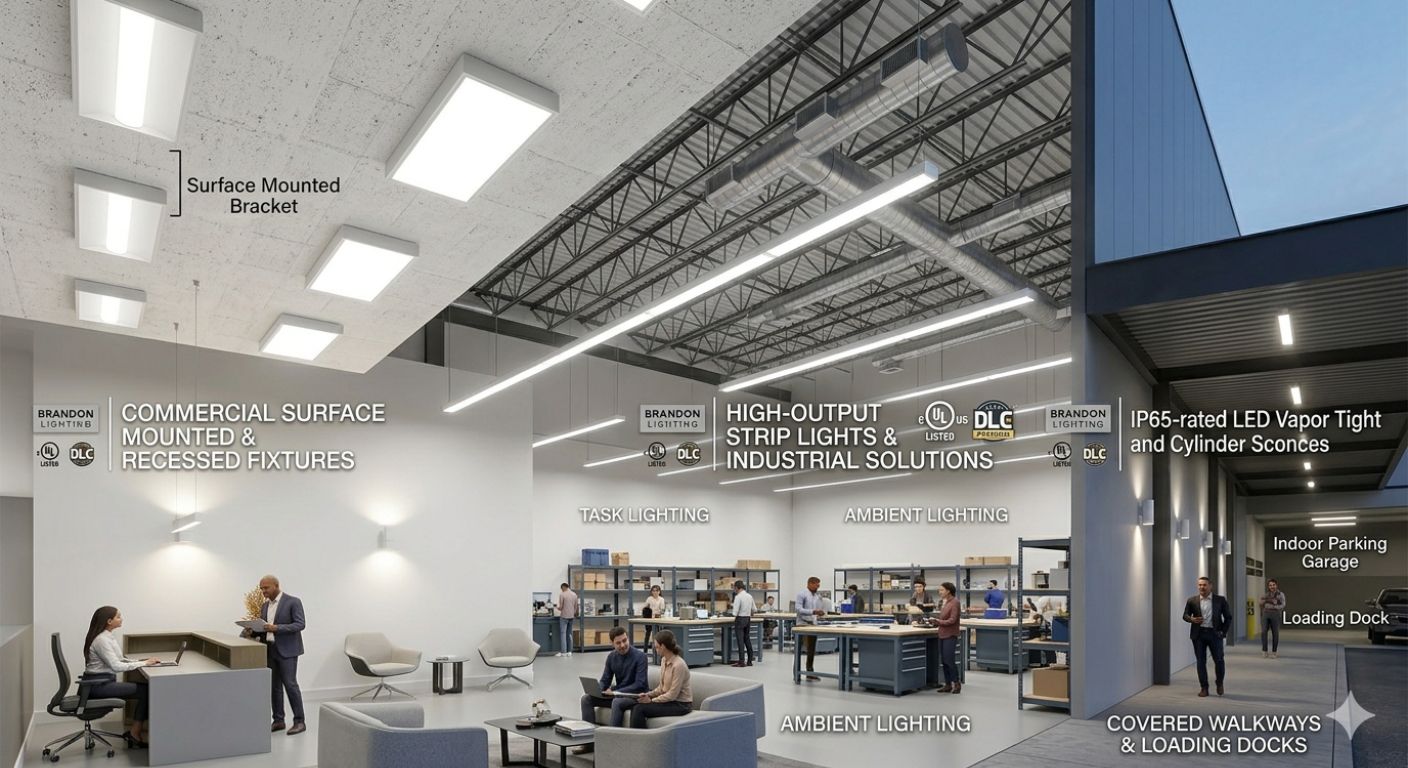
For main grocery aisles and dry goods shelving, Commercial LED Linear Strip Fixtures are one of the strongest lighting solutions available. They support continuous-run installation, which creates clean, uninterrupted illumination across long shelf runs. That uniformity helps customers read packaging quickly and improves merchandise visibility from multiple viewing angles. In dense aisle layouts, this approach is often more effective than isolated light sources.
From an operating cost standpoint, LED Linear Strip Lights also improve energy efficiency. They reduce electricity bills, lower maintenance demands, and replace traditional fluorescent lighting with a more stable performance profile. Brandon Lighting positions these fixtures for projects that need strong shelf illumination, reliable operation, and practical energy savings without complicating installation across large supermarket footprints.

Continuous-Run Uniformity and High CRI Performance
Continuous-run systems solve a common aisle problem: patchy brightness. In long gondola runs, breaks in illumination can create dark sections, inconsistent shelf visibility, and weaker product presentation. Continuous linear layouts improve uniformity so merchandise appears clear from one bay to the next.
That consistency also supports vertical shelf illumination. When the fixture line is centered and aligned with the aisle, product packaging on both sides reads more evenly. For B2B specifiers, this means fewer complaints about dark facings and better photometric control across standard grocery modules.
High CRI performance is the second advantage. CRI above 90 helps packaging colors, label details, and brand differentiation stand out. In grocery environments where customers compare similar products side by side, better color rendering improves recognition and strengthens confidence at the shelf.
Field-Selectable CCT, Wattage, and Optics—Brandon 4-4-4 Series
One modern trend in supermarket lighting is adaptability. Store layouts change, departments shift, and fixture stocking can become expensive for distributors. Brandon Lighting addresses this with the Brandon 4-4-4 Series, a field-adjustable platform offering 4 selectable CCTs, 4 wattages, and 4 light distributions in one fixture family.
This flexibility improves lighting adaptability during installation and cuts SKU pressure in distribution. Contractors can tune output to match store design needs without changing fixture lines, while maintaining stable performance across different aisle conditions.
Text table:
| Selectable Feature | Project Benefit | Typical Application |
|---|---|---|
| 4 CCT options | Matches department ambiance and merchandise presentation | Grocery, bakery, dry goods |
| 4 wattage options | Adjusts lumens to target fc levels and energy savings | Remodels and new builds |
| 4 light distributions | Improves shelf coverage and vertical illuminance | Main aisles and display runs |
| One fixture platform | Reduces distributor inventory complexity | Multi-site rollouts |
Specifying Lighting for Refrigerated Zones and Moist Environments
Refrigerated lighting must handle cold temperatures, moisture, and sanitation demands without sacrificing output. Walk-in coolers, seafood counters, meat prep zones, and freezer rooms place more stress on fixtures than standard sales floors, so specification needs to prioritize reliable operation first.
At the same time, you still need to control energy consumption and support safety and compliance. The right fixture should resist water and dust ingress, maintain lumen performance in sub-zero conditions, and fit food-handling environments. That is where vapor-tight solutions become essential.
Freezer Lighting Fixtures and Walk-In Cooler Lights—Vapor Tight Tri-Proof Solutions
Freezer lighting fixtures and walk-in cooler lights must operate where condensation, washdown exposure, and cold air are constant. Standard indoor luminaires are not built for that. In these areas, LED Vapor Tight Fixtures provide the moisture resistance and durable housing needed for long-term use.
Vapor Tight Tri-Proof Lights are especially suited to fresh seafood counters, meat preparation departments, commercial walk-in coolers, and industrial freezers. Their sealed construction helps protect internal components from water and dust while supporting reliable operation in harsh environments.
They also offer energy efficiency benefits. LEDs reduce maintenance compared with traditional light sources, and these fixtures are designed to maintain high lumen output even in sub-zero temperatures. For grocery projects, that combination of freezer lighting durability and operating efficiency is a practical specification requirement, not an upgrade.

Ensuring Safety, Compliance, and Sanitation with IP65/IP66 & NSF Ratings
In food-related environments, safety and compliance cannot be treated as optional. Fixtures used near washdown zones, cold storage, and preparation areas must be selected for their protection level, not just their lumen package. IP65 and IP66 ratings indicate resistance to water and dust ingress, which is essential for dependable performance.
Sanitation is the second issue. In food-handling spaces, NSF-focused fixture selection supports cleaner operation and better alignment with hygiene expectations. That makes LED Vapor Tight Fixtures a stronger fit for supermarket back-of-house and refrigerated departments than general-purpose interior products.
For North American projects, Brandon Lighting also aligns with the broader compliance expectations B2B buyers look for, including UL, cUL, DLC V5.1, and NSF listed products. That combination helps contractors and specifiers reduce risk while maintaining reliable operation in demanding supermarket conditions.
Conclusion
In conclusion, selecting the right lighting for grocery stores is paramount for enhancing customer experience and ensuring product visibility. With the right solutions, such as Brandon Lighting’s Commercial LED Linear Strip Fixtures for main aisles and LED Vapor Tight Fixtures for refrigerated zones, you can achieve optimal illumination while adhering to safety and compliance standards. Our extensive experience in the industry, along with our commitment to quality and innovation, establishes us as the ideal partner for your commercial projects. Whether you’re looking for energy-efficient options or customizing your lighting strategy, we are here to support your needs. Get in touch with us to explore how Brandon Lighting can illuminate your grocery store effectively and efficiently.
Frequently Asked Questions
What are the energy efficiency advantages of supermarket LED lighting?
LED lighting improves energy efficiency by reducing energy consumption, lowering maintenance needs, and cutting electricity bills across large supermarket footprints. It also supports energy savings in refrigerated and aisle applications, helping operators reduce environmental impact while replacing traditional fluorescent lighting with longer-lasting, stable-performance systems.
Which lighting solutions are optimal for produce, meat, and deli sections?
The right lighting solutions depend on the product type. Fresh produce benefits from warm white light around 3000K with high CRI above 90 for strong visual appeal. Meat is often enhanced near 2500K, while food presentation in service zones should prioritize accurate color temperature and dependable CRI performance.
Are there specific US lighting codes or standards to follow in supermarket projects?
Yes. Supermarket projects should prioritize compliance, safety, and application-specific lighting requirements, especially in refrigerated and food-handling areas. Brandon Lighting supports North American store design needs with UL, cUL, DLC V5.1, and NSF listed products, helping contractors and specifiers address regulations and reduce project risk.

Leave A Comment