
Key Highlights
- Proper commercial kitchen lighting is crucial for safety, efficiency, and compliance with health standards.
- Key factors to consider include brightness, color temperature (4000K-5000K is ideal), and high CRI for accurate food color representation.
- LED lighting offers significant energy efficiency, leading to lower utility bills and reduced replacement costs.
- Fixtures in commercial kitchens must be durable, often requiring NSF certification and high IP ratings (IP65+) for heat, moisture, and grease resistance.
- Meeting safety standards from bodies like the FDA and OSHA is mandatory and ensures a safe working environment.
- A layered lighting design using ambient, task, and accent lighting minimizes shadows and glare.
Introduction
In any high-paced restaurant, the commercial kitchen lighting system is far more than a basic utility; it is a critical component influencing staff safety, operational efficiency, and overall success. In these demanding environments, the right kitchen lighting enhances productivity and helps maintain strict health codes. A well-designed system, featuring the appropriate light fixture for each area, creates a workspace where chefs and staff can perform their duties with precision, ensuring food quality and a safer environment for everyone.


Key Considerations for Commercial Kitchen Lighting
Choosing the right commercial kitchen lighting involves more than just selecting fixtures. You must carefully assess the specific lighting requirements for different tasks and work surfaces. This includes evaluating brightness levels, color accuracy, and fixture durability to meet the unique demands of a busy kitchen.
Ultimately, your lighting needs should align with established safety standards to create a secure and productive environment. The best lighting solution combines bright, clear illumination for task-oriented areas with durable, heat-resistant fixtures. This ensures both high visibility for staff and compliance with health regulations, making the kitchen safer and more efficient. The following sections will explore these considerations in greater detail.
Importance of Brightness and Proper Lighting Levels
Proper brightness and appropriate lighting levels are pivotal in enhancing the functionality of commercial kitchens. Adequate illumination not only improves task visibility in food preparation areas but also ensures compliance with safety standards, such as those set by the National Sanitation Foundation. Balancing ambient and task lighting helps minimize eye strain during long shifts, intending to create efficient and safe working environments. By incorporating high CRI LED lighting with suitable color temperatures, kitchen staff can maintain food quality while achieving energy savings and reducing replacement costs of lighting fixtures.
Color Temperature and Visibility in Food Prep
Color temperature plays a critical role in how staff perceive food color and overall kitchen ambiance. Measured in Kelvin (K), a cooler color temperature, typically between 4000K and 5000K, is ideal for food prep areas. This cool white light closely mimics natural daylight, allowing chefs to accurately judge the freshness of ingredients and the doneness of cooked dishes.
Another vital factor is the Color Rendering Index (CRI), which measures how accurately a light source reveals the true colors of objects. For commercial kitchen lighting, a high CRI of 80 or above is recommended. This ensures that the subtle color variations in vegetables, meats, and other ingredients are clearly visible, which is crucial for food quality and safety.
Using lights with a low CRI can distort food color, potentially leading to errors in preparation and quality control. Therefore, selecting fixtures with both the appropriate color temperature and a high CRI is a popular and effective design idea for any professional kitchen. This combination enhances visibility and supports the high standards required in food service.
Choosing Fixtures for Durability and Longevity
Commercial kitchens are harsh environments characterized by high temperatures, steam, grease, and frequent cleaning. Therefore, the durability of each light fixture is paramount. Selecting industrial-grade fixtures designed to withstand these conditions ensures longevity and minimizes operational disruptions and replacement costs.
A key indicator of durability is the Ingress Protection (IP) rating, which classifies a fixture’s resistance to solids and liquids. For kitchens, a rating of IP65 or higher is recommended to protect against dust and water jets used during cleaning. Fixtures should also be vapor-tight to prevent moisture from compromising the internal electronics, especially in high-humidity areas.
Investing in durable fixtures provides several benefits, including enhanced safety and reduced maintenance. Consider these features when making your selection:
- Heat Resistance: Fixtures must operate reliably in areas with high temperatures, such as above cooking lines.
- Vapor-Tight Seals: Gasketed enclosures prevent steam and grease from entering the fixture.
- Shatterproof Construction: Using fixtures with shatterproof lenses or coatings prevents glass contamination in food prep zones.
Types of Lighting Fixtures Used in Commercial Kitchens
A variety of lighting fixtures are used to meet the diverse needs of a commercial kitchen. The right combination of kitchen lights ensures that every corner is properly illuminated, from general spaces to specific workstations. Common choices include troffers for broad lighting, high bay lights for rooms with tall ceilings, and smaller fixtures like strip lights for targeted tasks.
Modern kitchens increasingly rely on LED light technology, available in various forms like linear fixtures, tube lights, and track lighting. These options offer flexibility and efficiency. When selecting fixtures, it’s important to match the type to the specific area and task to create a safe and functional lighting scheme. We will now examine the advantages of LEDs and other specific fixture types.
Benefits of LED Light Fixtures for Commercial Use
The switch to LED lighting has become a standard in modern commercial kitchen lights due to its numerous advantages over traditional options like fluorescent and halogen bulbs. The most significant benefit is superior energy efficiency. LED fixtures can reduce energy consumption by 50-75%, which translates directly into lower electricity bills for businesses that operate long hours.
Beyond cost savings, LEDs generate significantly less heat. This is a major advantage in a hot kitchen environment, as it helps reduce the overall ambient temperature and lessens the load on HVAC systems. Furthermore, LED lighting boasts a very long lifespan, often exceeding 50,000 hours. This durability drastically reduces maintenance needs and replacement costs.
The cumulative benefits make LED lighting a smart financial and operational decision. Key advantages include:
- Substantial energy efficiency and lower utility costs
- Reduced heat output for a cooler kitchen
- Long lifespan minimizes maintenance and replacement costs
- Instant-on brightness with no warm-up period
- Glass-free designs improve food safety
Surface-Mounted vs. Recessed Lighting Options
When planning your industrial kitchen lighting, you’ll need to decide between surface-mounted and recessed lighting fixtures. Recessed lights are installed within the ceiling, offering a sleek, minimalist look. This flush-mounted design is easy to clean and reduces the accumulation of dust and grease, making it a hygienic choice, especially in open-concept kitchens visible to customers.
On the other hand, surface-mounted fixtures are attached directly to the ceiling’s surface. This makes them easier to install, access, and maintain, which is a significant advantage in a fast-paced environment where downtime must be minimized. Many durable, vapor-tight fixtures are available in surface-mounted designs, making them highly practical for back-of-house areas where function is more important than form.
The choice often depends on ceiling height, installation constraints, and aesthetic preferences. A buyer’s guide should help you weigh these factors to determine the best fit for each kitchen zone.
| Feature | Recessed Lighting | Surface-Mounted Lighting |
|---|---|---|
| Installation | Installed within the ceiling cavity | Attached directly to the ceiling surface |
| Aesthetics | Sleek, minimalist, and unobtrusive | More visible, functional appearance |
| Maintenance | Can be more difficult to access for repairs | Easy to access for replacement and maintenance |
| Cleaning | Easier to clean with a smooth ceiling line | Fixture surfaces can collect dust and grease |
| Best For | Open kitchens, areas where aesthetics matter | Back-of-house, areas with solid ceilings |
Track Lighting and Linear Fixtures Explained
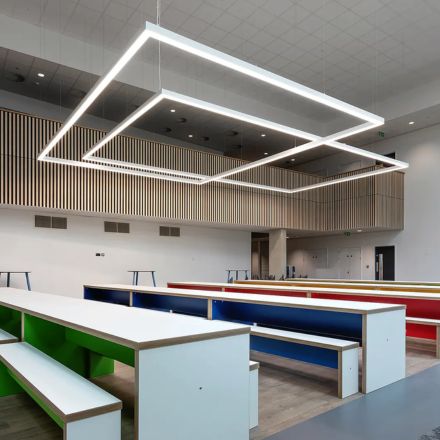
Linear lights have become a staple in commercial kitchens for providing broad, even illumination across large work areas. Typically available as long strip lights, these fixtures can be surface-mounted, suspended, or recessed. Their primary benefit is the ability to eliminate shadows and deliver consistent brightness over prep counters, cooking lines, and dishwashing stations, meeting critical lighting needs for these zones.
In contrast, track lighting offers directional flexibility. This system consists of individual light heads mounted on a track, which can be moved and aimed precisely where light is needed. This makes track lighting ideal for highlighting specific workstations, accenting open kitchen features, or adapting to changing kitchen layouts. It provides targeted illumination that complements the general lighting provided by linear fixtures.
A popular and effective lighting design idea is to use a combination of both. Employ linear lights for essential ambient and task lighting across primary work areas, and use track lighting to add focused light for specialized tasks or to enhance the visual appeal of customer-facing kitchen spaces. This layered approach ensures both functionality and versatility.
Lighting for Different Areas Within a Commercial Kitchen
Every zone in a commercial kitchen has a unique function, and its lighting should reflect that. A one-size-fits-all approach is ineffective; instead, a tailored lighting layout is necessary to optimize safety and productivity. Different light levels and fixture types are required for food preparation areas, cooking areas, and dishwashing areas.
From the intense, focused light needed over work surfaces to the durable, moisture-resistant fixtures in storage areas and wet zones, each space has specific requirements. The following sections provide recommended lighting layouts for different areas, ensuring that every part of your kitchen is equipped for peak performance and safety.
Food Preparation Zones and Workstations
Food preparation zones are where the most detailed work occurs, making high-quality lighting non-negotiable. These prep areas demand bright, focused task lighting to ensure accuracy and safety during cutting, chopping, and mixing. The recommended light level for these workstations is between 750 and 1000 lux (approximately 75-100 foot-candles).
To guarantee food quality and safety, the kitchen lights in these zones must have a high CRI (Color Rendering Index) of 90 or above. This high level of color accuracy allows chefs to correctly identify the freshness of ingredients, spot imperfections, and assess the doneness of food. Without a high CRI, subtle color cues that indicate spoilage or quality could be missed.
The ideal lighting layout for prep areas involves placing linear fixtures directly above the workstations to provide even, shadow-free illumination across the entire surface. This ensures that employees are not working in their own shadow. High-quality, flicker-free LED fixtures are recommended to reduce eye strain and fatigue during long shifts.
Cooking Stations, Grill Lines, and Ovens
Cooking areas, including grill lines and ovens, present some of the most challenging conditions for lighting fixtures. These zones are characterized by high heat, steam, and airborne grease particles. Therefore, the fixtures used must be exceptionally durable and specifically rated for such environments.
An LED light designed for high-temperature applications is essential. These fixtures have advanced heat management systems to prevent premature failure. They must also be sealed and have a high IP rating (IP66 or higher) to protect against moisture and grease infiltration, which can cause electrical hazards and damage. For added functionality, some operations use pendant lights for targeted illumination, though they must also be appropriately rated.
In addition to durability, lighting in cooking areas must provide clear visibility for staff to monitor food safely. Consider the following for these zones:
- High-Temperature Rating: Fixtures must be able to withstand ambient temperatures that can exceed 120°F.
- Vapor-Tight Enclosures: Sealed housings protect against steam, grease, and cleaning sprays.
- Emergency Lighting: Ensure emergency lights are installed for safe evacuation during a power failure.
Dishwashing, Cleaning, and Wet Area Solutions
Dishwashing areas and other cleaning zones are defined by constant high humidity, splashing water, and steam. These damp environments require lighting solutions specifically designed for wet locations. The most critical feature for fixtures in these areas is a high Ingress Protection (IP) rating.
An IP rating of IP65 or higher is necessary to ensure the fixture is protected from water jets and moisture. This rating confirms the fixture has a sealed, waterproof enclosure that prevents water from reaching the internal electrical components, thus avoiding short circuits and safety hazards. Vapor-tight fixtures with silicone gaskets are the standard for these applications.
Proper illumination in dishwashing areas is also crucial for sanitation, allowing staff to inspect dishes for cleanliness. For any wet area, your lighting solution should include:
- A high IP rating (IP65+) for water resistance.
- Vapor-tight construction to protect against high humidity.
- Durable, corrosion-resistant materials.
- Sufficient brightness (500-750 lux) for thorough inspection.
Best Practices for Lighting Design and Layout
A successful lighting design goes beyond simply installing fixtures; it requires a strategic layout that balances different types of light. An effective lighting plan layers general lighting for overall visibility with focused lighting for specific tasks. This approach ensures every part of the kitchen is properly illuminated without creating harshness or shadows.
By thoughtfully combining ambient lighting with task and accent lighting, you can create a workspace that is not only safe and efficient but also visually comfortable for your staff. The following sections will discuss best practices for achieving this balance, covering how to minimize glare, layer light sources, and design a plan centered on staff safety.
Minimizing Shadows and Reducing Glare
Two of the biggest challenges in kitchen lighting are shadows and glare. Shadows on work surfaces can obscure details, leading to preparation errors and increasing the risk of accidents. Glare, which is harsh reflection from stainless steel counters, can cause significant eye strain and headaches for staff over a long shift.
To address these issues, a popular design strategy is to focus on the placement and type of fixtures. Proper task lighting should be positioned to illuminate work surfaces directly from above or the side, preventing employees from casting shadows over their own work. The light quality is also important; using fixtures with diffusers or frosted lenses helps soften the light and spread it more evenly.
To effectively minimize shadows and glare, consider implementing these techniques:
- Layered Lighting: Combine overhead ambient light with focused task lights to fill in potential shadows.
- Proper Fixture Placement: Avoid placing bright lights directly in the line of sight or at angles that create harsh reflections.
- Use of Diffusers: Select fixtures with diffusers to scatter light and reduce sharp, glaring hot spots.
Layering Ambient, Task, and Accent Lighting
A well-designed kitchen lighting layout uses a layered approach that combines three main types of light: ambient, task, and accent. This method ensures that all lighting requirements are met, creating a space that is both functional and visually balanced.
Ambient lighting provides the general, overall illumination for the entire kitchen. It’s the base layer of light, typically provided by large ceiling-mounted or recessed lighting fixtures. This ensures safe navigation throughout the space. Task lighting is more focused and is directed at specific work areas like prep counters, cooking stations, and sinks. It provides the bright, direct light needed to perform jobs safely and accurately.
Finally, accent lighting is used to highlight specific features, such as an open-kitchen pass or architectural details. While less common in back-of-house areas, it can be used to add visual interest and depth. By layering these three types, you create a comprehensive lighting plan that is adaptable, efficient, and tailored to the unique needs of your kitchen.
Creating an Efficient Lighting Plan for Staff Safety
An efficient lighting plan is fundamental to creating a safe working environment. The primary goal is to ensure staff safety by providing adequate visibility in all work areas, from bustling cooking lines to storage rooms. A comprehensive plan eliminates hazards like shadows and dark corners where trips and falls could occur.
Your lighting plan must include designated emergency lights. These battery-backed fixtures automatically activate during a power outage, illuminating exit pathways and helping staff evacuate safely. Placing these emergency lights strategically near exits, along corridors, and in key work zones is a critical aspect of any safety-focused design.
Ultimately, a lighting plan that prioritizes staff safety combines bright, uniform illumination with specialized fixtures and emergency preparedness. By carefully considering the layout of work areas and potential hazards, you can design a system that not only meets regulatory codes but actively protects your employees from accidents, ensuring a secure and productive kitchen.
Meeting Safety, Health, and Energy Standards
Beyond functionality, commercial kitchen lighting is heavily regulated to protect public health and ensure a safe workplace. Compliance with various safety standards is not optional; it’s a legal requirement that impacts everything from fixture selection to energy consumption. These rules are in place to ensure safe food processing and handling.
Adhering to the specific lighting requirements set by food safety authorities and energy codes is essential for any food service operation. The following sections will outline the key standards you need to meet, including U.S. food safety laws, energy efficiency mandates, and compliance for hazardous zones.
Commercial Kitchen Lighting Requirements by U.S. Food Safety Laws
In the United States, commercial kitchen lighting is governed by strict safety standards to prevent food contamination and ensure worker safety. The FDA Food Code specifies minimum lighting requirements for different areas to guarantee that staff can properly inspect food and clean equipment.
A key standard in the industry is NSF certification. The National Sanitation Foundation (NSF) certifies products that are safe for use in food processing environments. An NSF certification on a light fixture means it has been rigorously tested for cleanability, durability, and material safety, ensuring it won’t contaminate food. Fixtures placed over food prep areas must be shatterproof or shielded to prevent glass from falling into food.
The essential requirements are designed to protect public health. Key mandates include:
- Minimum Light Levels: The FDA requires specific foot-candle levels for different zones, such as 50 foot-candles for food prep surfaces.
- Shatterproof Fixtures: All lights over food areas must be shatter-resistant or have protective coverings.
Energy Efficiency and Cost Savings with Modern Lighting
For any commercial kitchen, where lights are on for long hours, energy efficiency is a major factor in controlling operational costs. Modern lighting fixtures, particularly LEDs, offer significant energy savings compared to older technologies. Upgrading your commercial kitchen lighting can reduce electricity consumption by up to 75%, leading to a substantial decrease in your monthly utility bills.
This high level of energy efficiency also means that LED fixtures generate less heat. This secondary benefit further reduces costs by easing the burden on your kitchen’s air conditioning system, another major source of energy consumption. The long lifespan of LEDs also contributes to savings by minimizing replacement and maintenance expenses.
Many utility companies offer rebates for upgrading to energy-efficient lighting, which can help offset the initial investment. The quick return on investment makes it a financially sound decision. Key benefits include:
- Drastically lower energy consumption and utility bills.
- Reduced strain on HVAC systems due to less heat output.
- Eligibility for rebates from utility companies.
Compliance Considerations for Wet, Humid, and Hazardous Zones
Commercial kitchens contain zones with high humidity, steam, and direct exposure to water jets during cleaning. Lighting fixtures in these areas must comply with specific safety standards to prevent electrical hazards. The key to compliance is understanding the Ingress Protection (IP) rating system.
An IP rating consists of two numbers. The first digit indicates protection against solid objects like dust, with a 6 being the highest rating (dust-tight). The second digit represents protection against liquids. For wet areas like dishwashing stations, a rating of 5 or higher is needed to withstand water jets. For areas with high humidity but no direct water contact, a damp-location rating may suffice.
Choosing the right fixture is crucial for safety and longevity in these challenging environments.
- First Digit: A rating of 6 is ideal for kitchens, indicating the fixture is fully protected from dust and grease particles.
- Second Digit: A rating of 5 or 6 ensures protection against water jets from any direction, making the fixture safe for hose-down cleaning.
Conclusion
In conclusion, effective lighting in a commercial kitchen is crucial for both safety and efficiency. By understanding the specific needs of different areas—from food prep to dishwashing—you can create a well-lit environment that minimizes shadows and glare while enhancing visibility. The choice of fixtures like LED lighting not only supports energy efficiency but also adheres to safety and health regulations, ensuring compliance with industry standards. As you design your kitchen lighting layout, prioritize the mix of ambient, task, and accent lighting to foster a productive workspace. Ready to elevate your kitchen’s lighting? Get quotes to find the best solutions tailored to your commercial kitchen needs.
Frequently Asked Questions
What type of lighting ensures safety and maximum visibility in commercial kitchens?
To ensure safety and visibility in commercial kitchens, use a layered lighting approach. Bright, high-CRI LED task lighting is best for work areas to achieve the proper light level. All kitchen lighting must be durable and meet safety standards, including being shatterproof and rated for the specific environment (e.g., wet or high-heat).
Which LED light fixtures are most recommended for busy kitchens?
For busy commercial kitchen lights, NSF-certified, vapor-tight linear LED fixtures are highly recommended. They offer excellent energy efficiency, durability, and even illumination. An LED light with a high IP rating (IP65+) is crucial for areas exposed to moisture and grease, ensuring longevity and meeting various lighting needs safely.
How do I determine the right brightness level (lumens) for my kitchen’s needs?
Determine the right light level by assessing the tasks in each area. General kitchen lighting or ambient lighting needs about 50 foot-candles. For detailed task lighting in prep areas, aim for 75-100 foot-candles. Use a lighting plan that layers these levels to ensure all zones are appropriately illuminated.


Leave A Comment