
Key Highlights
- Effective healthcare lighting solutions are essential for enhancing patient care and staff performance in healthcare facilities.
- Proper lighting plays a critical role in improving patient comfort, reducing stress, and supporting the healing process.
- Different areas in medical facilities, such as patient rooms and surgical suites, have unique lighting requirements.
- Modern lighting can support infection control and hygiene protocols within healthcare environments.
- Energy-efficient options like LED lighting offer significant energy savings and sustainability for hospitals.
- Adhering to established lighting standards ensures safety and accreditation for healthcare providers.
Introduction
Lighting in healthcare settings goes far beyond simple illumination; it is a fundamental component of effective patient care. The right lighting solutions can create a healing environment, reduce stress for patients, and improve the efficiency of healthcare professionals. From patient rooms to operating theaters, a well-designed lighting system supports both the well-being of individuals and the operational needs of the facility. This guide will explore the essential elements of creating effective healthcare lighting that enhances safety, comfort, and performance.
Critical Considerations for Healthcare Lighting Design
When selecting healthcare lighting solutions, several factors are paramount to ensure the system meets the complex needs of healthcare settings. The importance of lighting extends to patient safety, staff efficiency, and the overall atmosphere of the facility. A comprehensive lighting system must be adaptable, reliable, and compliant with industry standards.
Considering these elements from the outset is crucial for a successful design. Key factors include balancing patient comfort with clinical needs, ensuring staff can perform tasks accurately, and maintaining a safe environment for everyone.
Patient Safety and Comfort
Patient safety and comfort are top priorities in any healthcare facility, and lighting plays a pivotal role in achieving both. Appropriate light levels can reduce the risk of falls and help patients navigate their surroundings confidently. During hospital stays, a well-lit environment contributes to a more positive patient experience, alleviating anxiety and creating a sense of security.
Furthermore, tunable lighting systems that mimic natural daylight can help regulate patients’ circadian rhythms, promoting better sleep and faster recovery. The ability to adjust light levels gives patients a sense of control over their environment, which is crucial for their well-being.
Ultimately, a thoughtfully designed lighting scheme enhances the healing process. By creating a calm and soothing atmosphere, proper lighting helps minimize stress and supports a better overall patient experience, which can lead to improved health outcomes.
Staff Performance and Well-Being
The quality of lighting in healthcare environments directly impacts the performance and well-being of healthcare professionals. Bright, glare-free illumination is essential for tasks that require precision and focus, such as administering medication or performing examinations. Adequate lighting helps reduce eye strain and fatigue, allowing staff to work more efficiently and accurately.
Beyond task performance, lighting also affects the mental state of employees. Working long shifts in poorly lit areas can increase stress levels and contribute to burnout. By contrast, well-designed lighting that mimics natural light can improve mood and alertness, creating a more positive and productive work environment for the entire team.
Investing in high-quality lighting is an investment in your staff. Supporting the well-being of healthcare professionals with optimal lighting conditions can lead to higher job satisfaction, reduced errors, and ultimately, better patient care.
Lighting Requirements for Different Healthcare Spaces
Different healthcare spaces have distinct functions, and their lighting conditions must be tailored accordingly. A one-size-fits-all approach is ineffective in a hospital, where a waiting room has vastly different needs than an operating room. Proper lighting design considers the specific activities and user requirements for each area.
From creating a comforting atmosphere in patient rooms to providing high-intensity light for surgical procedures, the design must be precise. The following sections will detail the specific lighting solutions recommended for various healthcare environments.
Patient Rooms and Recovery Areas
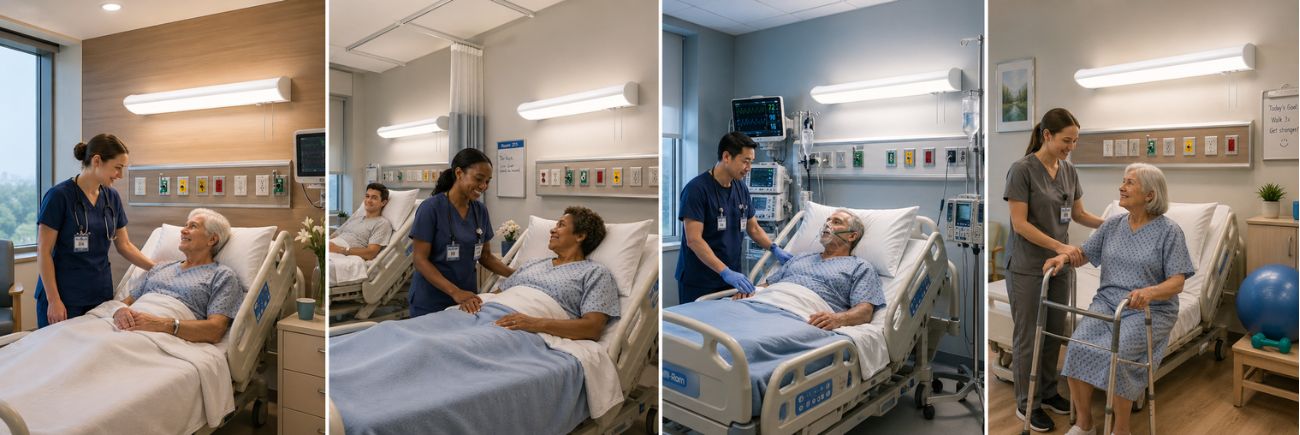
In a patient room, the goal is to create a comfortable environment that promotes healing and rest. This is achieved through a layered lighting approach. Ambient lighting provides general, soft illumination, while task lighting is available for reading or examinations. Dimmable controls allow patients to adjust light levels to their preference, increasing patient satisfaction.
Incorporating natural light through daylight harvesting is also highly beneficial. Large windows and skylights connect patients with the outdoors and help regulate their internal clocks. When natural light is unavailable, tunable white lighting can simulate the changing color temperature of daylight, from a cool morning light to a warm evening glow.
Ultimately, the right lighting in recovery areas supports both physical and emotional well-being. A flexible and patient-centric lighting design, like the Saros Duo luminaire which offers ambient, exam, and reading modes, can significantly enhance the healing journey.
Surgical Suites and Procedure Rooms
Lighting in operating rooms and surgical suites is mission-critical. During complex medical procedures, surgeons require high-intensity, shadow-free illumination to ensure precision and safety. Adequate lighting with a high color rendering index (CRI) is essential for accurately assessing tissue and fluid colors.
The color temperature of the lights must also be carefully selected. Cooler tones are often preferred as they can enhance concentration and visual acuity for the surgical team. It is vital that the lighting system provides consistent, reliable performance without generating excess heat that could cause discomfort.
Best practices for surgical lighting involve a combination of ambient and focused task lights, all designed to meet stringent healthcare standards.
| Lighting Zone | Recommended Practice |
|---|---|
| Surgical Field | High-intensity, shadowless task lighting with high CRI. |
| Ambient Room | General illumination that reduces contrast and eye strain. |
| Control Systems | Easily adjustable controls for intensity and color temperature. |
Infection Control and Hygiene Through Lighting Solutions
Beyond illumination, healthcare lighting solutions can play an active role in infection control. In environments where hygiene is paramount, the design and material of light fixtures are critical. Selecting fixtures that are easy to clean and do not harbor pathogens helps maintain clean environments.
Newer technologies are also emerging that use light itself to combat microorganisms. These advancements offer an additional layer of protection in the ongoing effort to reduce hospital-acquired infections, making lighting a key partner in patient safety.
Antimicrobial Lighting Technologies
A significant innovation in healthcare environments is antimicrobial lighting. These efficient lighting technologies use specific wavelengths of light to continuously disinfect surfaces and the air, helping to reduce the presence of harmful bacteria, viruses, and fungi. This provides an added layer of infection control without the use of harsh chemicals.
This technology can be integrated into standard lighting fixtures, providing both illumination and disinfection. It works by targeting microorganisms and disrupting their cellular functions, which prevents them from reproducing. This is particularly valuable in high-traffic areas and patient care zones where the risk of transmission is higher.
Key benefits of antimicrobial lighting include:
- Continuous disinfection that works around the clock.
- Safe for use in occupied spaces, enhancing patient and staff safety.
- Reduces the microbial load on surfaces, complementing manual cleaning protocols.
Best Practices for Maintaining Clean Environments
Maintaining hygiene in healthcare facilities requires a multi-faceted approach, and lighting solutions are a key part of it. The design of light fixtures should support, not hinder, cleaning protocols. Fixtures with smooth, non-porous surfaces and sealed enclosures are easier to wipe down and prevent the accumulation of dust and contaminants.
For example, recessed luminaires with sealed designs are ideal for clinical areas because they present a flat surface that is simple to clean. The materials used in these fixtures should also be resistant to the harsh chemicals often used in hospital-grade disinfectants, ensuring longevity and performance.
To support hygiene and maintenance, consider the following best practices:
- Select fixtures rated for healthcare environments, like those with an IP65 rating, which are dust-tight and protected from water jets.
- Choose luminaires with smooth, easily accessible surfaces to simplify cleaning.
- Integrate lighting into a comprehensive cleaning strategy to ensure all areas are addressed.
Energy Efficiency and Sustainability in Healthcare Lighting
Hospitals are 24/7 operations with significant energy consumption, making energy efficiency a top priority. Modern lighting solutions offer a powerful way to reduce energy costs while promoting sustainability. By upgrading to more efficient technologies, healthcare settings can achieve substantial energy savings without compromising light quality.
Implementing smart controls further enhances this efficiency. These systems ensure that light is used only when and where it’s needed, minimizing energy waste and lowering the facility’s overall environmental footprint, which is a key goal for forward-thinking institutions.
LED Lighting Benefits for Hospitals
Switching to LED lighting systems offers hospitals a multitude of benefits. As one of the most effective lighting technologies available, LEDs provide significant energy savings, consuming far less power than traditional fluorescent or incandescent bulbs. This reduction in energy use translates directly into lower utility bills.
Beyond cost savings, LEDs have a much longer lifespan, which reduces maintenance needs and replacement costs. This is particularly advantageous in a hospital setting where disrupting patient care to change a lightbulb is not ideal. LEDs also generate less heat, which can help lower the load on HVAC systems.
The primary benefits of using LEDs in hospitals include:
- Reduced Energy Consumption: LEDs use up to 80% less energy than traditional lighting.
- Longer Lifespan: Lasting tens of thousands of hours, LEDs minimize maintenance.
- Enhanced Controllability: LEDs are easily integrated with dimmers and smart controls for greater flexibility.
Strategies for Reducing Energy Consumption
To maximize energy savings, healthcare facilities can implement several strategies to reduce energy consumption beyond just upgrading to LEDs. Smart controls are a cornerstone of this effort. Occupancy sensors, for instance, automatically turn lights off in unoccupied rooms, offices, or storage areas, eliminating wasted electricity.
Similarly, daylight sensors can dynamically adjust the output of electric lights based on the amount of natural light available. In areas with large windows, these sensors can dim the lights on bright days, saving energy while maintaining consistent illumination levels for occupants.
Integrating lighting controls with building automation systems provides the most comprehensive approach. This allows for centralized management and scheduling of all lighting.
- Use occupancy sensors in non-patient areas like offices and break rooms.
- Install daylight sensors in spaces with ample natural light.
- Connect lighting to a building automation system for scheduled adjustments.
Conclusion
In conclusion, effective healthcare lighting solutions are essential for optimizing patient care and staff productivity in medical facilities. By prioritizing aspects such as patient safety, comfort, and energy efficiency, healthcare lighting design can significantly impact the overall experience for both patients and healthcare providers. The integration of antimicrobial technologies and adherence to best practices in maintenance further enhances hygiene and infection control. As you plan or upgrade your healthcare lighting, keep these critical considerations in mind to create a safe, efficient, and welcoming environment. If you have questions or need assistance, feel free to get in touch for expert guidance on implementing these solutions in your facility.
Frequently Asked Questions
What lighting standards should U.S. healthcare facilities follow for safety and accreditation?
U.S. healthcare facilities should follow lighting standards from the Illuminating Engineering Society (IES), specifically ANSI/IES RP-29-20. Adhering to these guidelines for proper lighting ensures patient safety and is crucial for meeting accreditation requirements from organizations like The Joint Commission, demonstrating a commitment to quality care.
How does daylighting or natural light affect healthcare environments?
Daylighting positively impacts healthcare environments by improving mood, reducing stress, and helping regulate patients’ circadian rhythms. Access to natural light in hospital spaces has been linked to better health outcomes, including shorter hospital stays and reduced need for pain medication, creating a more healing atmosphere for everyone.
What are recommended lighting solutions to support patient comfort in medical facilities?
To support patient comfort in medical facilities, recommended lighting solutions include tunable white lighting that mimics natural daylight patterns and dimmable fixtures that give patients control over their environment. High light quality with good color rendering also enhances the space, improving patient satisfaction and creating a less clinical feel.


Leave A Comment