
Key Highlights
- Upgrading to specification-grade LED lighting is a critical investment for modern industrial facilities, directly impacting operational costs and ROI.
- Properly designed lighting solutions significantly enhance worker safety, boost productivity, and improve visual comfort on the factory floor.
- Field-adjustable technology simplifies inventory for distributors and accelerates on-site installation for electrical contractors.
- A Make-to-Order (MTO) manufacturing model eliminates the risk of obsolete stock and ensures access to the latest component technology.
- Dual-origin manufacturing in China and Thailand provides supply chain security, mitigating tariff risks and ensuring delivery resilience.
- Zoning your plant with the correct fixtures—from high bays to vapor tights—optimizes energy efficiency and reduces long-term maintenance costs.
Introduction
In today’s advanced manufacturing landscape, the stakes for operational excellence are higher than ever. Designing the right lighting system is no longer a secondary consideration but a core strategic decision with profound impacts on energy costs, ROI, worker productivity, and safety. Outdated lighting wastes capital and compromises facility performance. This guide provides a comprehensive framework for designing and specifying high-performance LED lighting for complex industrial settings. It is engineered to help facility managers, distributors, and contractors navigate the technical and logistical challenges of modern industrial illumination.
Optimizing LED Lighting for Advanced Manufacturing Environments
Achieving optimal performance in advanced manufacturing requires a lighting system engineered for precision, reliability, and efficiency. Industrial LED lighting is the definitive solution, offering unparalleled control over the operational environment. By strategically implementing modern LED lights, facilities can see dramatic improvements in every aspect of their operations, from the production line to the balance sheet. Superior energy efficiency is just the beginning.
The right lighting solutions go beyond simple illumination; they create a safer, more productive atmosphere in demanding industrial settings. Below, we will explore the tangible benefits of upgrading to industrial-grade LED technology and how it directly addresses the core challenges faced by facility managers and contractors.
Key Benefits of LED Solutions for Industrial Facilities
The primary driver for upgrading to industrial LED lighting solutions is the significant and immediate financial return. LEDs are fundamentally more efficient than traditional lighting options like fluorescent or metal halide, converting a much higher percentage of electricity into usable light. This superior energy efficiency translates directly into lower utility bills and substantial long-term energy savings.
Beyond the energy cost reductions, the operational benefits are compelling. LED fixtures have an exceptionally long lifespan, often rated for 50,000 hours or more. This durability drastically reduces maintenance costs and the labor associated with frequent bulb replacements, minimizing operational disruptions on the factory floor.
Furthermore, these systems offer a range of advantages that enhance the facility’s overall performance. The key benefits include:
- Massive Energy Savings: LED technology uses up to 75% less energy than incandescent bulbs and other traditional systems, directly cutting operational expenses.
- Reduced Maintenance Costs: The long lifespan and durability of industrial LEDs mean fewer replacements and less frequent maintenance cycles.
- Superior Durability: Built to withstand vibration, dust, and moisture in industrial settings, LEDs are far more robust than their conventional counterparts.
Enhancing Safety, Productivity, and Visual Comfort with LEDs
A well-designed lighting system is fundamental to creating a safer work environment. High-quality LED illumination provides bright, uniform light that eliminates shadows and dark spots, significantly improving visibility across the factory floor. This enhanced clarity reduces the risk of accidents, especially in areas with heavy machinery or fast-moving assembly lines. The crisp, clear light renders colors accurately, helping workers identify hazards and read labels with greater precision.
Improved visual comfort is another critical factor that directly impacts productivity. The high-quality light produced by modern LEDs reduces eye strain and worker fatigue, which is common under the flickering, poor-quality light of older systems. When workers can see their tasks clearly without discomfort, their accuracy and efficiency naturally increase. This leads to fewer errors, higher output, and a more focused workforce.
Ultimately, the goal is to provide consistent, high-quality illumination that supports demanding industrial tasks. By engineering a lighting plan that prioritizes visual comfort and eliminates glare, you not only meet safety standards but also create an environment where your team can perform at its peak. This investment in lighting is an investment in your people and your output.
Selecting the Right LED Fixture Types for Manufacturing Zones
Not all areas of an industrial facility have the same lighting requirements. A successful lighting plan involves zoning the plant and matching specific fixture types to the tasks and environmental conditions of each area. From high-ceiling warehouses to precision assembly lines, selecting the appropriate luminaire is crucial for optimizing performance, safety, and energy efficiency. Factors like ceiling height, required foot-candles, and the presence of environmental hazards must be carefully considered.
Choosing the right LED warehouse lighting involves more than just brightness; it requires an understanding of beam angles, color temperature, and durability ratings. The following sections will provide clear guidance on selecting high bay, low bay, linear strip, and vapor tight fixtures for their intended applications within your facility.
High Bay and Low Bay LED Applications
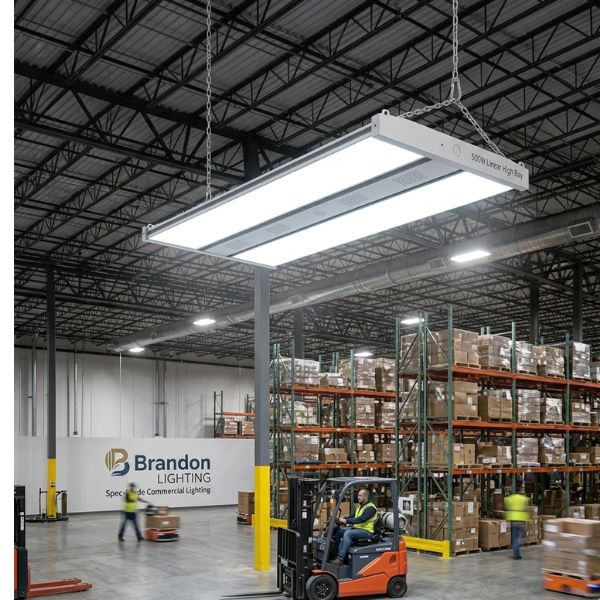
In large industrial settings with high ceilings, such as heavy manufacturing plants, distribution centers, and open warehouses, high bay LED fixtures are the standard. These powerful luminaires are engineered to deliver a high amount of light from significant heights, typically 20 feet or more. The key is to specify the correct beam angle to ensure uniform illumination at the floor level, avoiding dark spots or excessive glare. UFO high bay lights are a popular choice for their efficient light distribution and compact form factor.
For areas with ceiling heights between 12 and 20 feet, low bay fixtures provide appropriate illumination without creating “hot spots” or overwhelming brightness. These are often used in workshops, smaller storage areas, and processing facilities. Both high bay and low bay industrial LED lighting solutions offer exceptional energy savings and longevity compared to the legacy metal halide systems they replace.
The table below outlines the ideal applications for each fixture type based on ceiling height.
| Fixture Type | Typical Ceiling Height | Common Applications |
|---|---|---|
| High Bay LED | 20 to 40+ feet | Warehouses, large factories, gymnasiums, aircraft hangars |
| Low Bay LED | 12 to 20 feet | Workshops, smaller storage areas, retail backrooms, garages |
Linear Strips and Vapor Tight Fixtures for Task-Specific Areas
For low-ceiling assembly lines, inspection stations, and precision task lighting zones, LED linear strips are an ideal solution. These fixtures provide clean, continuous illumination directly over the work surface, minimizing shadows and ensuring workers have the clarity needed for detailed tasks. Their slim profile allows for easy integration into workstations and along conveyor systems, delivering focused light exactly where it is needed most. This approach to task-specific lighting is essential for maintaining quality control and worker productivity.
In areas exposed to non-corrosive moisture, dust, or temperature fluctuations, vapor tight fixtures are non-negotiable. These rugged, sealed luminaires are designed for durability in harsh environments. Their robust construction protects the internal components from contaminants, ensuring reliable performance and a long service life.
Common applications for these specialized fixtures include:
- Vapor Tight Fixtures: Food processing facilities, cold storage, parking garages, and covered outdoor areas like loading docks (under overhangs).
- Linear Strips: Assembly lines, quality control stations, and any area requiring focused, low-glare task lighting.

Engineering Field-Adjustable Lighting for Distributor and Contractor Success
In the B2B supply chain, inventory complexity is a significant liability. Holding dozens of SKUs for every possible combination of wattage, color temperature (CCT), and distribution pattern ties up capital and warehouse space. Field-adjustable LED lighting solutions directly solve this problem. These fixtures are engineered with selectable CCT and wattage settings, allowing one product to cover the needs of multiple applications.
This technology empowers distributors to serve a wider range of projects with a fraction of the inventory. For electrical contractors, it provides on-the-fly flexibility to adapt to unforeseen site conditions or client preference changes without causing project delays. We will now examine how this technology streamlines logistics from the warehouse to the job site.
Streamlining Inventory with Selectable CCT, Wattage, and Distribution
The financial burden of dead stock is a major pain point for lighting distributors. Products with fixed specifications can sit on shelves for months if demand shifts, tying up cash flow. Field-adjustable technology effectively eliminates this risk by consolidating multiple SKUs into a single, versatile fixture. A luminaire with selectable CCT and selectable wattage allows distributors to meet diverse project requirements with a dramatically reduced inventory count.
This flexibility is a strategic advantage. Instead of stocking fixtures for every possible lumen package and color temperature, you can stock one highly adaptable unit. This approach not only frees up capital but also ensures that the products you carry have a faster turnover rate, maximizing profitability and warehouse efficiency.
The key benefits for inventory management include:
- Reduced SKU Count: One fixture can replace three, four, or even more fixed-spec products.
- Increased Flexibility: Easily adapt to customer requests for different light levels or color temperatures without ordering new products.
- Lower Inventory Risk: Minimize the chance of being stuck with obsolete or slow-moving stock.
Accelerating Installation and Reducing SKU Complexity on Job Sites
For electrical contractors, time is money. Delays on the job site due to incorrect product specifications can derail project timelines and erode profit margins. Field-adjustable fixtures provide a critical layer of insurance against these issues. If a client decides they want a cooler light temperature in one area or a lower power consumption in another, the adjustment can be made instantly on-site with the flip of a switch. This eliminates the need to reorder products and wait for new shipments, keeping the installation process moving forward.
This on-site adaptability simplifies logistics for project estimators and managers. Instead of specifying and tracking dozens of different fixture types for a single project, they can standardize on a few versatile products. This reduces the chance of ordering errors and makes material management significantly easier. The contractor arrives on-site with the confidence that their fixtures can meet the precise needs of each space.
Furthermore, this technology gives contractors a powerful tool during client walk-throughs. They can demonstrate different lighting effects in real-time, helping the facility manager make an informed decision and ensuring final sign-off is achieved without complication or change orders.
Conclusion
In conclusion, the integration of advanced LED lighting solutions in manufacturing facilities is not just a matter of aesthetics; it’s about enhancing safety, productivity, and operational efficiency. By understanding the specific needs of different manufacturing zones and leveraging technologies such as field-adjustable lighting, businesses can streamline their operations while minimizing inventory complexities. The Make-to-Order model also offers significant advantages by eliminating the risks associated with stale stock and ensuring tailored solutions that meet precise project requirements. As you consider your lighting needs, don’t hesitate to reach out for tailored quotes that align with your facility’s demands. Your journey to optimized lighting begins with the right partnership.
Frequently Asked Questions
What are the typical lumen and CRI requirements for manufacturing environments?
Lumen requirements vary by task, from 30 foot-candles for general areas to over 70 for detailed inspection zones. Industry standards typically recommend a Color Rendering Index (CRI) of 80+ for most industrial lighting applications to ensure accurate color perception for safety and quality control.
How does the Make-to-Order model benefit lighting distributors and facility managers?
The Make-to-Order (MTO) model gives distributors and managers access to the latest LED lighting technology without the risk of holding obsolete inventory. It ensures every batch is built to exact specifications, optimizing logistics and eliminating dead stock. This guarantees you receive customized lighting solutions tailored to your project’s needs.
Are LED solutions customizable for unique industrial applications in the United States?
Yes. As a specification-grade manufacturer, we provide highly customizable LED lighting solutions for unique industrial settings across the United States. Our Make-to-Order model allows for tailored lumen packages, fixture lengths, and other modifications to meet precise engineering requirements for any application.


Leave A Comment